Most people treat ChatGPT like a magic 8-ball: Ask a question, get an answer, move on.
However, elite users—the top 0.1%—are doing something completely different.
Instead of asking ChatGPT for simple answers, they are asking it to think like a consultant.
Consequently, the results are staggering: 74% accuracy vs. 4% accuracy, according to a Princeton study. 
💡 What You’ll Learn
A prompting technique called Tree of Thoughts (ToT)—so simple you will wonder why nobody taught you this on day one. Furthermore, it works with ChatGPT, Claude, Gemini, and all major AI models.
What is Tree of Thoughts (And Why Only 0.1% Use It)
Tree of Thoughts (ToT) is a prompt engineering framework that mimics how expert consultants actually solve problems.
Therefore, instead of asking AI for a single answer, you are structuring the prompt to:
- Generate 3+ parallel strategies (explore different paths)
- Evaluate each on specific criteria (pros/cons, cost, time, risk, ROI)
- Prune weak options (force the AI to explain why ideas fail)
- Deliver the best recommendation with a step-by-step action plan
In essence, think of it like hiring three expert advisors, watching them debate, and then choosing the winner. 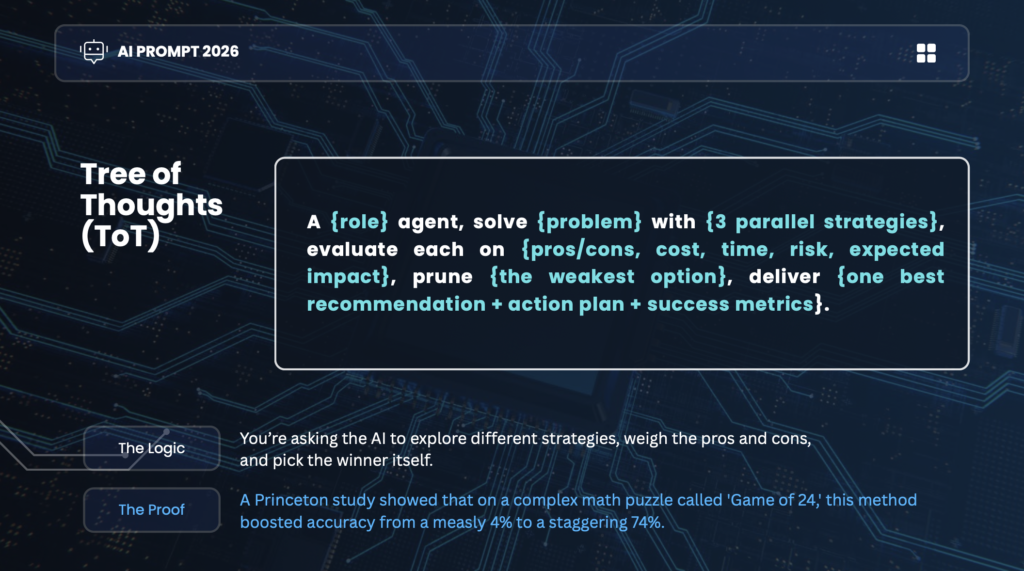
✅ Works on Every AI Model
- ChatGPT (GPT-4, GPT-4o, GPT-o1)
- Claude (Sonnet, Opus)
- Google Gemini (Pro, Flash, Ultra)
- Any LLM that supports structured prompting
The Princeton Study That Proved It Works
Specifically, researchers at Princeton tested Tree of Thoughts on a complex math puzzle called “Game of 24.”
The task: Use four numbers to make 24 (e.g., 4, 9, 10, 13 → solve it).
Results:
- Standard prompting: 4% success rate
- Tree of Thoughts prompting: 74% success rate
Ultimately, that represents an 18.5x improvement.
The Copy-Paste Formula (Use This in 60 Seconds)
To get started quickly, here is the exact Tree of Thoughts formula. Simply copy it, customize the variables, and paste it into ChatGPT, Claude, or Gemini:
You are a {role} agent. Solve {problem} with {3 parallel strategies}.

Evaluate each on:
- Pros/Cons
- Cost
- Time
- Risk
- Expected Impact

Prune {the weakest option} and explain why.

Deliver {one best recommendation + action plan + success metrics}.
Why This Formula is Genius
First, let’s break down each part:
You are a {role} agent → Activates expert mode
For example: “You are an ecommerce growth strategist”
Why it works: As a result, the AI adopts domain-specific knowledge and vocabulary.
Solve {problem} with {3 parallel strategies} → Forces exploration
For instance: “Increase monthly revenue by 40% with 3 strategies”
Why it works: Consequently, this prevents first-answer bias.
Evaluate each on [criteria] → Structured decision-making
Specifically: Cost, time, risk, ROI
Why it works: Because of this structure, the AI can’t hand-wave away trade-offs.
Before vs. After: The Difference is Shocking
❌ What 99.9% of People Do (Weak Prompt)
❌ What You Get
Basically, you get a generic listicle you could’ve found on any blog. Furthermore, there is no prioritization, no ROI analysis, and absolutely no idea where to start.
✅ What the Top 0.1% Do (Tree of Thoughts Prompt)
✅ Result
As a result, you don’t waste time on 10 random tactics. Instead, you execute ONE proven strategy with confidence. Ultimately, that’s the real power of Tree of Thoughts.
3 More Real-World Examples (Copy-Paste Ready)
You are a B2B SaaS PM. Goal: Double free-to-paid conversion.

Context: {current_funnel_metrics}, {core_value_moment}, {persona},
{pricing_tiers}, {top_competitors}.

Generate 3 distinct conversion strategies (e.g., onboarding redesign,
paywall_design, trial_offer, in-product_nudges).

Score each on: dev_effort (low/med/high), risk, expected_lift,
time_to_ship.

Prune the weakest.

Deliver: 1 winning strategy + PRD-style requirements + event
tracking plan.
Use case: SaaS founders, product managers
You are a personal finance coach.

Goal: Increase savings rate to 25%.

Inputs: {monthly_income}, {fixed_costs},
{variable_spend_by_category}, {debt_payments}, {goals}.

Propose 3 budget strategies (e.g., zero-based, 50/30/20,
targeted_cuts).

Evaluate: sustainability, stress_level, savings_%,
risk_of_rebound_spending.

Prune the least realistic plan.

Deliver: A weekly routine + check-in checklist + adjustment rules.
Use case: Personal finance, budgeting
You are a YouTube growth strategist.

Goal: Increase subscribers by 50% and stabilize views.

Inputs: {channel_niche}, {last_10_videos_metrics},
{audience_retention}, {upload_capacity}, {monetization_goal}.

Create 3 growth strategies (e.g., series_format, shorts_funnel,
collabs).

Evaluate: production_load, growth_potential, algorithm_risk,
brand_fit.

Prune one.

Deliver: A 4-week content calendar + title/hook templates +
KPI targets.
Use case: Content creators, YouTubers
Common Mistakes to Avoid
❌ Mistake #1: Too Vague
For example, a bad prompt is: “You are a business consultant. Help me grow my business.”
This fails because there are no metrics, no constraints, and no evaluation criteria.
❌ Mistake #2: Only 1-2 Strategies
Similarly, a bad approach is: “Think in 2 strategies…”
Consequently, it fails due to a lack of diversity. However, generating 3 or more strategies forces the AI to explore edge cases.
❌ Mistake #3: No Pruning
Lastly, a bad instruction is: “Generate 3 strategies and deliver all of them.”
In this case, it fails because you want the AI to decide, rather than just dumping options on you.
FAQ
Q: Does this work with GPT-4, Claude, Gemini?
A: Generally, yes. Furthermore, ToT works with any advanced LLM (GPT-4, Claude Sonnet 4, Gemini 2.0). However, it may be less effective with older models like GPT-3.5.
Q: How long should my prompts be?
A: In most cases, longer is better if it adds context. For instance, the examples above (200-300 words) are ideal. Therefore, don’t add fluff, but do not skip key constraints.
Q: Can I use this for creative writing?
A: Technically yes, but it is often overkill. Instead, ToT shines for strategic or operational problems. For creative writing, try “Self-Reflection” prompting instead.
📚 AI Prompt Mastery Series
Part 1 of 5 • Collect all parts to get 100 prompts!
20 copy-paste prompts
20 copy-paste prompts
20 copy-paste prompts
20 copy-paste prompts
20 copy-paste prompts
Download Part 1 now and start using these prompts in 60 seconds:
📥 Download Part 1 (20 Tree of Thoughts Prompts)
✅ No email required · Free forever · Works with ChatGPT, Claude, Gemini
💡 Why 5 parts instead of 1 big file?
Each framework (Tree of Thoughts, Self-Reflection, etc.) solves different problems. Therefore, download Part 1 now, try the prompts, and then come back for Part 2 when you’re ready to level up again. Ultimately, focused learning beats information overload.
Why This Actually Works
Fundamentally, here’s the thing most people don’t get about AI:
Because ChatGPT, Claude, and Gemini are trained on billions of examples of average thinking, they tend to output average responses.
As a result, when you ask a simple question, you inevitably get an average answer.
Conversely, when you use Tree of Thoughts, you’re activating a completely different part of the model—the part that’s seen expert consultants, strategists, and decision-makers at work.
In fact, you aren’t just asking for a single answer. Rather, you are asking the AI to roleplay as an expert who debates with themselves before deciding.
Ultimately, that changes everything.
What Happens When You Start Using This
Week 1: You’ll feel like you have an unfair advantage
- Initially, your first ToT prompt will blow your mind.
- Following that, you will wonder why nobody taught you this before.
- Eventually, you will start using it for everything.
Week 2: You’ll get addicted
- Furthermore, expect to customize the formula for your specific needs.
- Then, you will build a personal prompt library.
- As a result, you can stop Googling for average advice.
Week 3: People will ask what changed
- By this stage, your strategies will be significantly sharper.
- Moreover, your execution will become faster.
- Ultimately, you will sound like you hired a $10,000/month consultant.
The Bottom Line
In conclusion, Tree of Thoughts isn’t just a simple hack. Rather, it represents a fundamental shift in how you use AI.
Unfortunately, most people will never learn this. Therefore, they will keep asking lazy questions and getting lazy answers.
However, things are different for you. Soon, you are about to join the top 0.1%.
🎯 Ready for Part 2?
You just mastered Tree of Thoughts. Next up: Self-Reflection Prompting — the technique that makes AI critique its own work and turn rough drafts into polished masterpieces.
What you’ll learn in Part 2:
- Draft → Critique → Rewrite workflow
- 20 copy-paste Self-Reflection prompts
- Real examples: reports, emails, creative writing
Coming soon! Bookmark this page to get notified.
Share This Guide
If this helped you, share it with someone who’s struggling with AI:
- Twitter: Click to Tweet
- LinkedIn: Share on LinkedIn
- Reddit: Post to r/ChatGPT
Complete AI Prompt Series:
- ✅ Part 1: Tree of Thoughts (20 prompts) ← You are here
- Part 2: Self-Reflection Prompting (20 prompts) – Coming soon
- Part 3: Meta-Prompting (20 prompts) – Coming soon
- Part 4: RAG Prompting (20 prompts) – Coming soon
- Part 5: ReAct Prompting (20 prompts) – Coming soon
💡 Bookmark this page to get notified when new parts are released!
Last updated: March 2026 | Reading time: 14 minutes | Works with: ChatGPT, Claude, Gemini