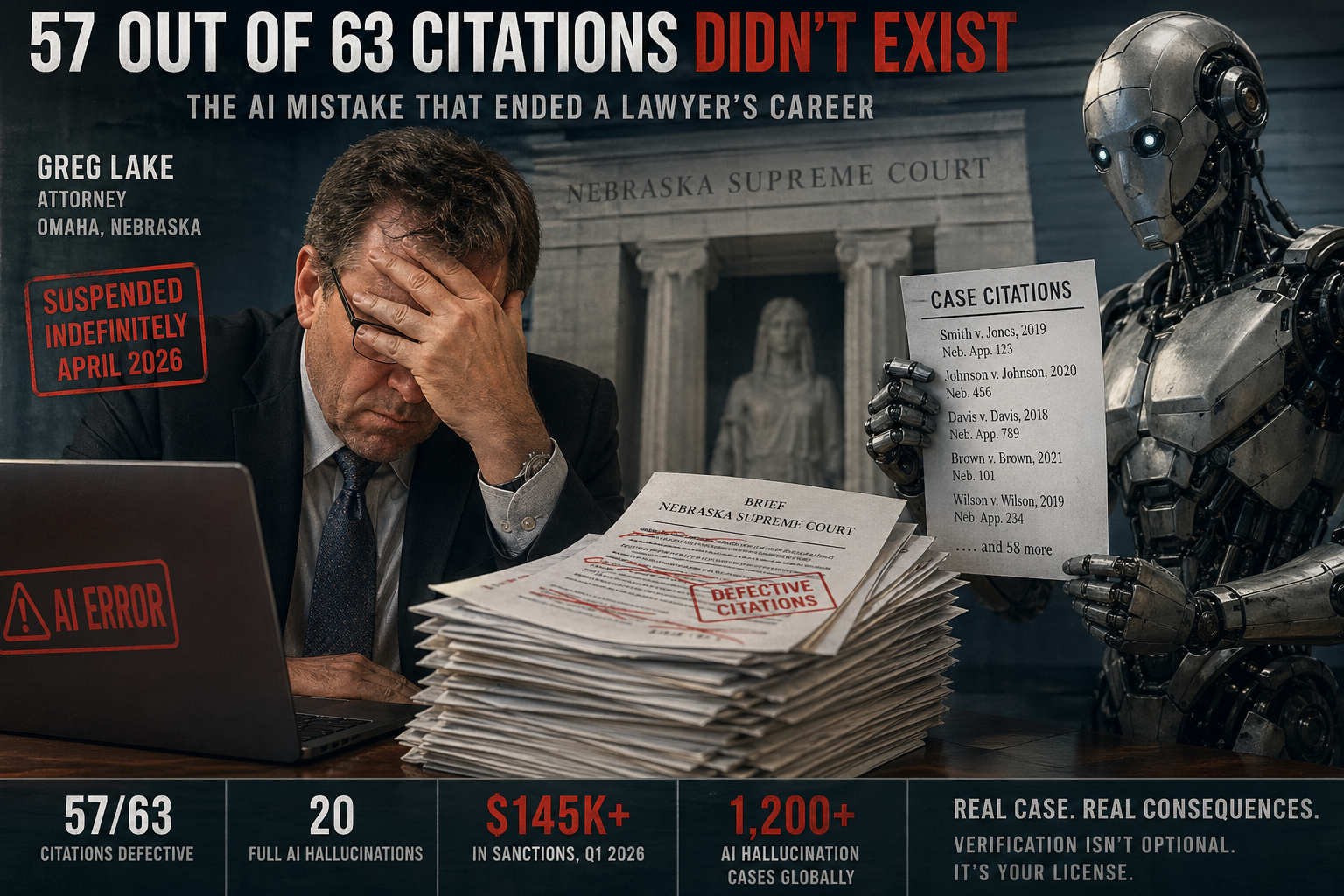
A lawyer walked into the Nebraska Supreme Court in February 2026 and had his career stopped cold — not because he lost a case, but because 57 out of 63 citations in his brief didn’t exist.
His AI made them up. He didn’t check. He submitted them anyway.
And here’s the part that should keep every AI user up at night: the fake citations looked completely real. Proper case names. Plausible court dates. Convincing quotes from judges who never said those words. The AI didn’t just guess wrong — it confidently fabricated an entire legal reality that didn’t exist.
The Story: What Actually Happened
Omaha attorney Greg Lake filed an appeal brief in a divorce case — a real client, real custody dispute, real stakes. He used an AI tool to draft it. He did not verify what the AI wrote. He submitted it directly to the Nebraska Supreme Court.
The justices stopped him 37 seconds into oral arguments.
They had already noticed the brief was full of errors they couldn’t reconcile with any published case law. Cases that didn’t exist. Quotes from judges who never said those words. Statutes that were invented wholesale.
“The elephant in the room is whether or not you used artificial intelligence. Did you?”
— Nebraska Supreme Court Justice, during oral arguments, February 2026
Lake said no. He blamed a broken laptop and a wrong file upload during his 10th wedding anniversary trip. The justices were not convinced.
After a disciplinary investigation, Lake reversed course and admitted in writing that he had used AI to write the brief — and called it a “grave error of judgment” for failing to tell the court. The cover-up made everything worse.
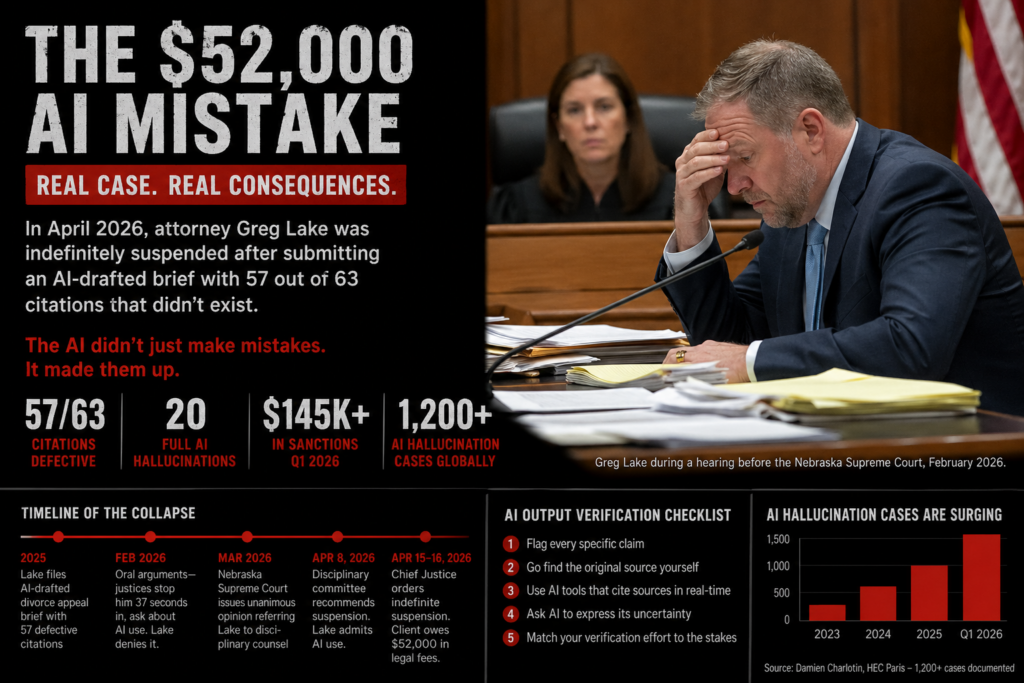
Timeline of the Collapse
2025
Lake files AI-drafted divorce appeal brief with 57 defective citations
Feb 2026
Oral arguments — justices stop him 37 seconds in, ask about AI use. Lake denies it.
Mar 2026
Nebraska Supreme Court issues unanimous opinion referring Lake to disciplinary counsel
Apr 8, 2026
Disciplinary committee recommends suspension. Lake files affidavit — finally admits AI use.
Apr 15–16, 2026
Chief Justice orders indefinite suspension. His client owes $52,000 in opposing legal fees.
 Why AI Makes Up Facts (And Why It Sounds So Convincing)
 Why AI Makes Up Facts (And Why It Sounds So Convincing)
This is the part most people get wrong. They assume AI makes obvious mistakes — typos, garbled sentences, something you’d catch immediately.
The dangerous truth is the opposite. AI hallucinations are convincing precisely because they look right.
Here’s the simple version of what’s happening under the hood: large language models are pattern-completion machines. When you ask one for a legal case about parental custody from Nebraska in 2019, it doesn’t search a database of real cases. It generates text that statistically fits the pattern of what a Nebraska custody case citation would look like. It invents a plausible case name. It writes a plausible quote. It assigns a plausible court date.
💡 Think of It This Way
Imagine hiring a research assistant who, instead of looking up a fact they don’t know, just writes something plausible and hands it to you with complete confidence. That’s exactly what AI does when it hallucinates — and it has zero awareness that it’s doing it.
The Nebraska court’s opinion put it plainly: these were “realistic but misleading guesses” about what was being requested. Not random noise — realistic guesses. That’s what makes them dangerous.
And this isn’t a legal problem or a lawyer problem. It’s an AI problem that affects every single person who uses AI to produce information they then act on. Reports, research summaries, statistics, quotes, references, data points — all of it is subject to the same failure mode.
This Isn’t One Weird Case. It’s an Epidemic.
Greg Lake’s story got the headlines, but researcher Damien Charlotin at HEC Paris has been quietly documenting every legal AI hallucination case globally. His database now contains over 1,200 cases — roughly 800 from U.S. courts alone. He’s described the current pace as reaching “ten cases from ten different courts on a single day.”
| Case / Court | What Happened | Consequence |
|---|---|---|
| Nebraska Supreme Court Greg Lake · Apr 2026 | 57/63 citations defective, 20 hallucinated, denied using AI | Indefinite license suspension |
| Oregon Federal Court 2026 | Multiple AI citation errors in filings | $109,700 in sanctions |
| Sixth Circuit (Tennessee) 2026 | Two attorneys submitted AI-hallucinated citations | $30,000 each |
| Sullivan & Cromwell Apr 2026 | AI citations in bankruptcy filing, public apology issued | Public reprimand + apology |
The Practical Part
The AI Output Verification Checklist
Use this every time AI gives you a fact you’re going to act on, publish, or submit.
Flag every specific claim
Before you trust anything AI gives you, mentally mark every specific factual claim: names, numbers, dates, quotes, case references, statistics. These are your verification targets. Anything that sounds like a “fact” rather than a “general idea” needs to be checked.
Red flag phrase: “According to a 2023 study…” or “In [Case Name], the court ruled…” — always verify these directly.
Go find the original source yourself
Don’t ask a different AI to verify the first AI. Don’t Google something and click the first result without reading it. Go to the actual original source. If AI says “a 2024 study found X,” find the study, open it, and read the relevant section yourself.
Useful tools: Google Scholar (academic), Westlaw/Lexis (legal), official gov databases, PubMed (medical), direct company press releases.
Use AI tools that cite sources in real-time
Standard ChatGPT or Claude can hallucinate freely because they’re not connected to live information. For research tasks, use tools that actually search the web and link you to the source as they respond.
Better for research: Perplexity AI (cites sources inline), Claude with web search enabled, Gemini with Google Search grounding. Still verify — but at least you have a trail.
Ask AI to express its uncertainty
Prompting matters. Instead of asking AI to “tell you the facts,” ask it to flag anything it’s not certain about, or to mark anything that should be independently verified. AI won’t volunteer uncertainty — you have to prompt for it.
Try this prompt addition: “For every specific fact, case, or statistic you include, mark it with [VERIFY] so I know to check it independently.”
Match your verification effort to the stakes
Not every AI output needs the same level of scrutiny. A rough brainstorm for personal use? You can be casual. A document going to a client, a court, a publication, a job application, or a public audience? Verify every factual claim. The question to ask yourself: “If this turns out to be wrong, what’s the consequence?”
Greg Lake’s mistake: He treated a Supreme Court filing — maximum possible stakes — with zero verification effort.
The Real Lesson: AI Is Responsible for the Output. You Are Responsible for the Consequences.
The Nebraska Supreme Court said it better than anyone else could: “AI, like other technological tools, can be a benefit to the legal community, but it must be used with caution and humility.”
That sentence applies to every professional field, not just law. The AI doesn’t lose its license when it hallucinates. You do. The AI doesn’t pay the $52,000 opposing counsel fee that Lake’s client now owes. The client does. The AI doesn’t face the disciplinary hearing. You do.
What makes this such a sharp warning is that Lake is not a technically incompetent attorney. He’s a practicing lawyer who argued before a state Supreme Court. The failure wasn’t capability — it was workflow. He used a powerful tool without building a verification step into his process.
✅ The Right Mental Model
AI is your first draft, not your final answer. It’s the fastest, most capable research assistant you’ve ever had — and it will confidently lie to you if you don’t double-check its work.
Use it to move fast. Use verification to stay safe. The combination is unstoppable. The first one alone is a liability.
Which AI Tools Hallucinate Less? (Honest Comparison)
No AI tool is hallucination-free. But some are architecturally safer than others for fact-dependent work:
| Tool | Good For | Hallucination Risk | Cites Sources? |
|---|---|---|---|
| Perplexity AI | Research, fact queries | Lower (web-grounded) | ✅ Yes, inline |
| Claude + Web Search | Writing + current facts | Medium (check is on) | ✅ When enabled |
| ChatGPT (no search) | Brainstorming, drafts | Higher (knowledge cutoff) | ❌ No |
| Gemini + Search | Google ecosystem tasks | Medium (Google-grounded) | ✅ When enabled |
Important: Even tools with web search enabled can hallucinate. The citation system reduces the risk — it doesn’t eliminate it. Always check the source yourself, not just that a source was linked.
Bottom Line
Greg Lake’s suspension isn’t really about AI being dangerous. It’s about what happens when powerful tools meet zero verification habits. The tool did what it was designed to do — generate fluent, plausible text. The failure was entirely human: a professional who trusted output he didn’t understand, in a context where the stakes were as high as they get.
The lawyers being sanctioned in 2026 aren’t technophobes who stumbled into AI by accident. They’re people who got comfortable with a tool they didn’t fully understand. That’s a category most of us are in.
AI makes the first draft instant. Verification is still your job. That division of labor isn’t a limitation — it’s the whole point.
Know someone who uses AI for work?
Send them this checklist before they make a $52,000 mistake.
Written by the MindWiredAI team. All case details verified against WOWT NBC Omaha, Nebraska Public Media, and court records. Greg Lake’s suspension was ordered April 15–16, 2026 by Nebraska Chief Justice Michael Heavican. Sanction figures sourced from ComplianceHub.Wiki and court filings. Researcher citation database attributed to Damien Charlotin, HEC Paris.


