
NVIDIA × HUGGING FACE · SEPTEMBER 2026
Is Hugging Face Still Free After the NVIDIA Deal?
The place where almost every free AI model lives just sold for $12.9 billion. NVIDIA promised to keep it open — it never promised to keep it free.
I read the announcement, the SEC filing, and Hugging Face’s current pricing docs. Then I checked what happened the last three times NVIDIA promised to keep something open.
The short version
Yes — and nothing can change until the deal closes in the first half of 2027. But NVIDIA’s promise covers openness, not price. The words “free,” “pricing” and “bandwidth” appear nowhere in the announcement or the SEC filing. Meanwhile Hugging Face was already trimming its free tier months before NVIDIA showed up.
You probably didn’t think of Hugging Face as something you use. But if you’ve ever run a model on your own laptop, downloaded a Stable Diffusion checkpoint, or clicked a free AI demo that someone built in a browser tab — you were standing on it.
That’s the uncomfortable part. It’s the water pipe, not the faucet. And on September 3, the water company got bought.
So let’s do the thing the launch coverage skipped: read what was actually signed, separate the promises from the wording, and figure out what you should do about it — which, spoiler, is a fifteen-minute job you can finish tonight.

What was actually signed
The deal is real and it’s a full acquisition, not a stake. NVIDIA’s announcement is a blog post written by Jensen Huang himself, published September 3.
The SEC filing has the numbers: roughly $11.9 billion to shareholders plus up to $1 billion in equity to retain Hugging Face employees. The agreement was signed September 2. And the line that matters most to you:
“The transaction is expected to close in the first half of 2027, subject to the satisfaction or waiver of customary closing conditions, including receipt of required regulatory approvals.”
Until then, Hugging Face is legally a separate company. NVIDIA cannot direct how it operates. Whatever you’re worried about, it cannot happen for at least nine months.
Two things the coverage stated confidently that the filing does not say: whether it’s cash or stock, and which regulators have to clear it. NVIDIA named neither. The merger agreement itself wasn’t filed as an exhibit, so nobody outside the deal can read the actual contract.
The promise everyone is quoting
Huang was unusually specific, and I want to give him credit for that before I take any away:
“Hugging Face will remain an open platform for the entire AI ecosystem. Developers will choose the models they want, the frameworks they want, the clouds and inference service providers they want and the computing platforms they want. NVIDIA compute will not be required to build on or deploy through Hugging Face.”
That last sentence is a clear, checkable commitment, and it’s more than most acquirers say. The SEC filing echoes it: NVIDIA “has committed to… keep Hugging Face’s platform open, consistent with Hugging Face’s existing practices.”
Now the fine print, in three parts.
It lives in a blog post, not a contract
There’s no term, no monitor, and no remedy if it’s broken. The one sentence that does sit in a legal document is filed under “Other Events” — a voluntary disclosure section. It describes a commitment; it isn’t the commitment.
And here’s the detail I did not expect to find. That same filing carries NVIDIA’s standard forward-looking-statements paragraph, which explicitly covers “post-closing plans” and then says the company “disclaims any obligation to update these forward-looking statements.” The openness promise is disclosed inside a document that disclaims any duty to keep it current.
“Consistent with existing practices” is a moving floor
The commitment is pegged to whatever Hugging Face does today. If Hugging Face’s own practices change first — and as you’ll see in a moment, they have been changing all year — the promise moves with them.
Nothing in it is about money
I searched the announcement, the filing, and the CEO’s public statement for the words free, pricing, price, cost, tier, bandwidth and storage. None of them appear in reference to what users pay.
The filing’s actual wording is that Hugging Face would “continue to permit… users to upload and download models and datasets of their choosing.” Permit. Not permit for free. A metered hub with paid downloads would satisfy that sentence word for word.
⚠️ The catch
“Open” and “free” are different words, and only one of them was promised. Open source stays open — that’s a licensing fact. Whether hosting and bandwidth stay free is a business decision nobody has committed to.
The free tier was already shrinking — before NVIDIA
This is the part that changed how I read the whole story, and I haven’t seen it anywhere else.
Go read Hugging Face’s own documentation and changelog. Through 2026, with no acquisition in sight, the free tier quietly got smaller:
| When | What changed for free users |
|---|---|
| April 2026 | Persistent storage removed from Spaces |
| July 2026 | Creating a new Space that runs on compute now requires a paid plan. Static Spaces stay free. |
| July 2026 | Download bandwidth metering shipped — usage is now visible in your dashboard |
| Current docs | Free public storage is described as “best-effort,” with no stated limit |
Nobody is charging for downloads today. But you don’t build a meter for something you intend to keep giving away forever. That’s worth watching regardless of who owns the company.
The honest framing, then, is this: the trend line was already pointing down, and it was Hugging Face’s own doing. NVIDIA didn’t start it. NVIDIA just bought the company doing it — and made a promise that specifically doesn’t cover it.
NVIDIA has actually made this promise before
Here’s the part that should carry the most weight, because it’s history rather than speculation.
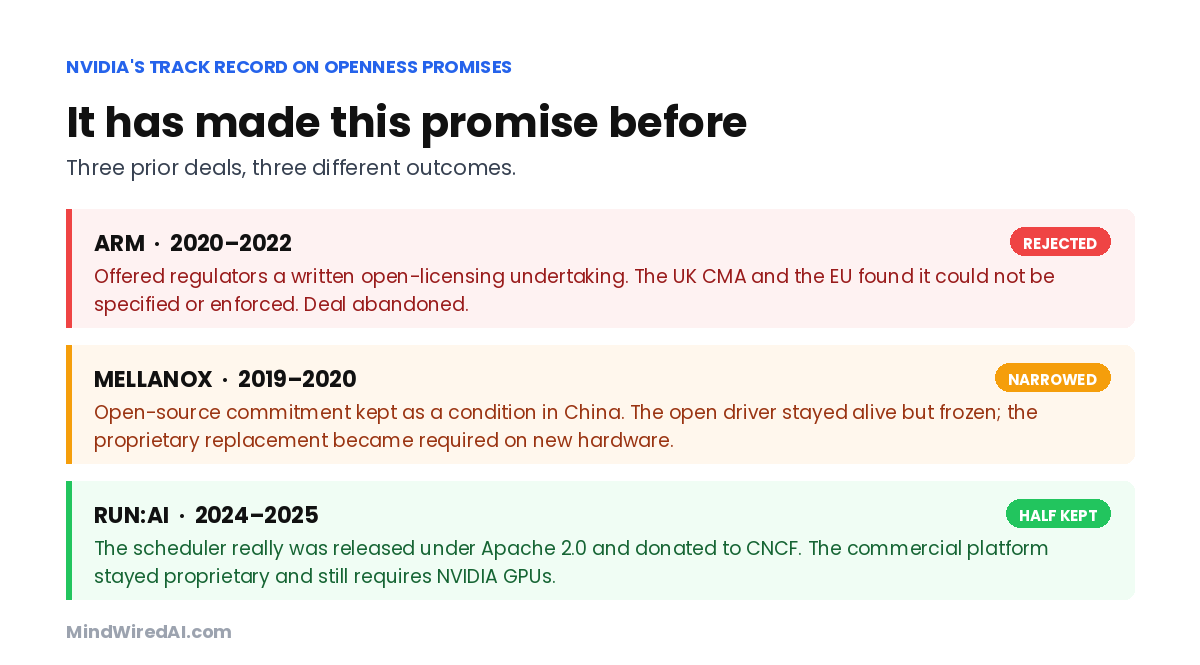
Arm: the same promise, in writing, rejected
When NVIDIA tried to buy Arm — the other famously neutral platform everyone builds on — it offered regulators a formal written undertaking to keep licensing open and equal. Not a blog post. A binding submission.
The UK competition authority’s conclusion, verbatim: the required conduct could not “be specified with sufficient clarity, to provide a lasting remedy that is capable of effective monitoring and enforcement.” It found “no form of behavioural remedy would address the competition concerns identified.” The European Commission considered NVIDIA’s commitments “insufficient” and didn’t even market-test them. The deal was abandoned in 2022.
So: NVIDIA has offered a stronger version of this promise before, to people whose job is to evaluate such promises, and they concluded it couldn’t be made enforceable. The Hugging Face version is weaker — and this time, no regulator has publicly said they’re even looking.
Run:ai: the fairest test, and a split verdict
In 2024 NVIDIA bought Run:ai, and its founders said open-sourcing the software would “extend its availability to the entire AI ecosystem.”
Part of that really happened, and I’ll say so plainly: the KAI Scheduler was released under Apache 2.0, NVIDIA handed the GitHub organization over to the community, and it was accepted into the Cloud Native Computing Foundation in December 2025. That is a promise kept, verifiably.
The other part didn’t. The commercial Run:ai platform stayed proprietary, and NVIDIA’s own installation docs still require an NVIDIA GPU Operator, with no mention of any other accelerator — twenty months after “the entire AI ecosystem.” One component was opened. The product was sold.
What has changed so far: nothing
I checked, because “nothing” is a finding and it deserves stating clearly.
Pricing. Unchanged. PRO is still $9 a month, Team $20 per user, Enterprise $50 per user.
Changelog. The most recent entry predates the announcement. There is not a single changelog item about the acquisition.
Model availability. No removals, no new gating found.
Hugging Face’s own blog. Silent. The company announced a $12.9 billion sale on social media and has published nothing about it on its own blog.
That last one is odd rather than alarming, but it’s the kind of detail worth noticing.
What to do tonight (about 15 minutes)
Not panic-downloading the internet. Just making sure the two or three models you’d actually miss exist somewhere other than someone else’s server.
1. Keep a local copy of the models you rely on
⚡ Every tutorial older than a year is wrong about this
The huggingface-cli command was renamed to hf and then removed entirely. If you copy an old command, it will fail with a deprecation error. Use hf.
Install: pip install -U huggingface_hub
Check the size first: hf download Qwen/Qwen3-8B --dry-run
Download it: hf download Qwen/Qwen3-8B --local-dir ./Qwen3-8B
Datasets too: add --repo-type dataset
Point it at an external drive by setting HF_HOME to a folder on that drive before you run it. Models are large — check the size first, then walk away and let it run.
2. Know where else your models live
| Alternative | Actually the same files? |
|---|---|
| ModelScope | ✓ Yes — I checked the file checksums against Hugging Face and they match exactly. Works without an account. |
| Kaggle Models | ✓ Yes for many major models. Needs a free account. |
| Ollama | ✗ No — it re-compresses models into its own format. A great way to run them, not a backup. |
| DeepSeek, gpt-oss | ✗ Hugging Face only. No alternative host exists. |
⚡ Do not hand your token to an unofficial mirror
Community mirror sites exist, and at least one instructs you to pass your Hugging Face access token to it. That routes a live credential through a stranger’s server. Never do this. If you already have, revoke the token in your Hugging Face account settings.
If you’re not running models locally yet and this all sounds abstract, my walkthrough for running a free local LLM with Ollama is the gentler place to start.
The honest limitations
Where I could be wrong, and where I couldn’t verify.
The contract is private. The merger agreement wasn’t filed publicly. There may well be a real, enforceable openness covenant inside it. Nobody outside the deal can check — which is exactly why I’m treating the public version as what we have.
Open source stays open regardless. Transformers, diffusers and datasets are Apache 2.0, and that license can’t be revoked on code already published. Anyone can fork today’s version permanently. What an owner controls is future direction and whose hardware gets first-class support — not the past.
The most-shared “reassurance” isn’t independent. The llama.cpp creator posted a warm response to the news. He works for Hugging Face — his project was acquired by them in February. That doesn’t make him wrong, but he isn’t an outside voice.
Some quotes I could only get secondhand. X was unreachable from every route I tried, so the CEO’s statement and that llama.cpp post are quoted here as reported by other outlets, not read directly at the source.
One outside voice worth ending on. Nithya Ruff, chair of the Linux Foundation board, told VentureBeat: “Neutrality is a discipline a company must choose time and again, not a promise it makes once.” That is the whole thing in one sentence.
Who should actually care
Worth 15 minutes if: your work depends on two or three specific open models, or you build free Spaces demos. Download local copies and note whether your models exist on ModelScope. That’s the whole job.
Worth a bookmark if: you use Hugging Face casually — a demo here, a model there. Nothing changes for at least nine months. Check back when the deal closes.
Ignore entirely if: you only use ChatGPT, Claude or Gemini. This doesn’t touch you. Your AI tools do not run on Hugging Face.
If you’ve been meaning to reduce how much of your setup depends on any single company, my list of free GitHub projects that replace paid AI subscriptions is a good weekend project.
Frequently asked questions
Is Hugging Face free right now?
Yes. Free accounts can still download models and datasets, host public repositories, and use static Spaces. Pricing has not changed since the announcement. The deal doesn’t close until the first half of 2027, and until then Hugging Face operates independently.
Did NVIDIA promise to keep Hugging Face free?
No. It promised to keep the platform open — that models stay downloadable, that other companies’ chips stay supported, and that NVIDIA hardware won’t be required. Price was never mentioned. The words “free,” “pricing” and “bandwidth” do not appear in the announcement or the SEC filing.
Will open-source models like Llama and Qwen disappear?
No. Open weights already released under permissive licenses can’t be un-released, and most major models are mirrored on ModelScope and Kaggle. The realistic risk isn’t disappearance — it’s that hosting and bandwidth stop being free, or that non-NVIDIA hardware gets less attention over time.
How do I download a Hugging Face model to keep?
Install with pip install -U huggingface_hub, then run hf download <model-name> --local-dir ./folder. The old huggingface-cli command no longer works — it was replaced by hf. Add --dry-run first to see the download size.
The bottom line
Nothing has changed, and nothing can until 2027. NVIDIA’s openness promise is more specific than most, and one of its three past promises was genuinely kept. This is not a disaster.
But the promise covers openness, not price — and Hugging Face was already metering downloads and charging for things that used to be free, months before NVIDIA appeared. Those two facts sit next to each other, and neither one is a secret. They just weren’t in the headlines.
Your one next step: pick the single model you’d be most annoyed to lose and run hf download <model> --local-dir ./folder tonight. If it takes fifteen minutes, you’re done thinking about this until 2027.


