Here’s the problem with most AI users.
They treat AI like a search engine.
Ask a question. Get an answer. Done.
But the most powerful AI outputs don’t come from one-shot prompts. They come from AI that can reason through a problem step-by-step, decide what to do next, take action, observe the result, and loop again until the job is done.
That’s called ReAct — and it’s the closest thing to having an AI that thinks like a professional.
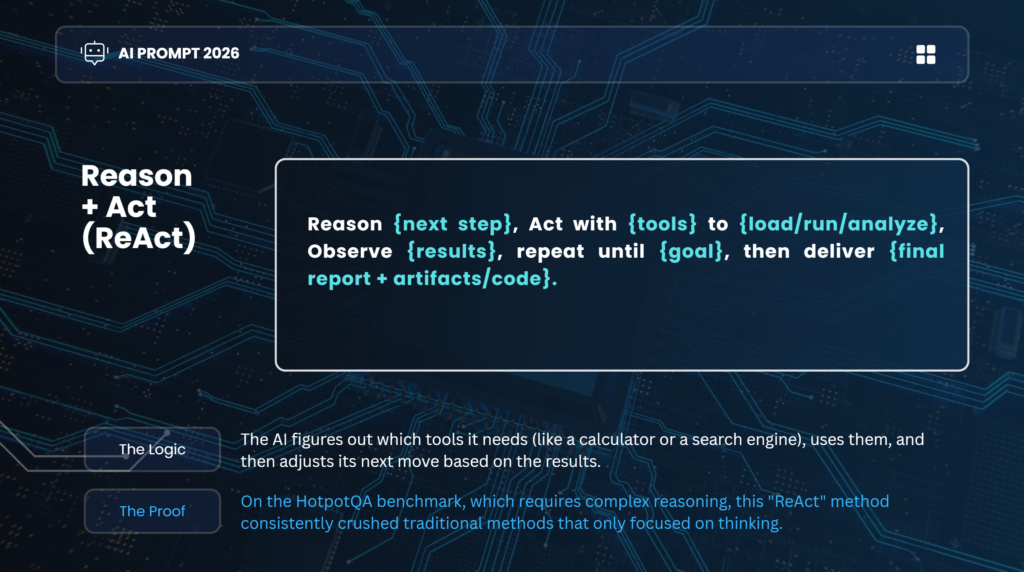
On the HotpotQA benchmark (which tests complex multi-step reasoning), the ReAct method consistently outperformed standard prompting by a wide margin. The difference? Instead of guessing once, ReAct iterates.
What You’ll Learn (Part 5 of 5 — The Final Chapter)
ReAct (Reason + Act): Make AI think before it acts, loop through observations, and self-correct in real time. This is the framework behind modern AI agents — and it’s the most powerful technique in this entire series. You’ve made it to the end. Let’s finish strong.
What is ReAct?
ReAct stands for Reason + Act. It’s a loop:
- Reason: AI thinks about what to do next based on the goal
- Act: AI uses a tool or takes a step (search, calculate, analyze)
- Observe: AI reads the result
- Repeat: Loops back to reason again — until the goal is reached
Think of it like a detective who:
- Forms a hypothesis
- Gathers evidence
- Revises the hypothesis based on what they found
- Takes action on the conclusion
Without ReAct: AI gives one answer and stops → misses nuance, makes assumptions
With ReAct: AI iterates, self-corrects, and builds toward a reliable conclusion
HotpotQA Benchmark Result
On HotpotQA — a benchmark requiring multi-hop, multi-step reasoning — the ReAct framework consistently outperformed chain-of-thought-only methods. Why? Because ReAct doesn’t just think. It acts on observations and adjusts. That feedback loop is where the performance jump comes from.
Why You Need This Now
Most people prompt AI once and accept the output. That’s fine for simple tasks.
But for complex, real-world work — data analysis, strategy, research, automation — you need AI that keeps going until it actually solves the problem.
Standard prompt:
“Analyze my sales data and find growth opportunities.”
AI Response: [Generic list of common business tips. No actual analysis.]
ReAct prompt:
“You are a data analyst agent. Goal: find 5 actions to increase profit. Loop: 1) Reason: decide what to analyze first. 2) Act: load the sales file and compute baseline metrics. 3) Observe: identify anomalies. 4) Repeat until goal is reached. Output: top insights + recommended actions + reproducible code.”
AI Response: [Loads data, spots Q3 dip, hypothesizes cause, segments by region, confirms hypothesis, outputs 5 specific actions with projected impact]
That’s the difference. One answer versus a working investigation.
The Copy-Paste Formula
Here’s the exact ReAct formula. Customize the {variables} and paste into ChatGPT, Claude, or Gemini:
Reason {next step}, Act with {tools} to {load/run/analyze},
Observe {results}, repeat until {goal},
then deliver {final report + artifacts/code}.
Why This Formula Works
Reason {next step}: Forces AI to plan before acting
Why it works: Prevents random, unfocused outputs
Act with {tools}: Specifies what the AI should use (Python, spreadsheet, web search)
Why it works: Grounds abstract reasoning in concrete tools
Observe {results}: Makes AI read and react to its own output
Why it works: Enables self-correction before the final answer
Repeat until {goal}: Loops the cycle as many times as needed
Why it works: Complex problems rarely get solved in one step
Deliver {report + code}: Ends with a tangible, usable output
Why it works: Forces AI to close the loop with something you can actually use
Before vs. After: Real Example
WITHOUT ReAct One-shot guessing
Find 5 actions to increase profit from my sales data.
Here are 5 ways to increase profit: 1) Raise prices. 2) Cut costs. 3) Improve marketing. 4) Launch new products. 5) Expand to new markets.
⚠️ Generic advice. Zero analysis of your actual data. Could apply to literally any business.
WITH ReAct Iterative agent loop
You are a data_analyst_agent. Goal: find_5_actions_to_increase_profit. Tools: Python, Spreadsheet. Loop: 1) Reason: decide what to analyze first. 2) Act: load sales_data.csv and compute baseline metrics. 3) Observe: identify anomalies/opportunities. 4) Repeat with next most valuable analysis. Output: top insights, recommended actions, reproducible code.
REASON: Start with revenue by product category to find top/bottom performers.
ACT: df.groupby('category')['revenue'].sum().sort_values()
OBSERVE: Electronics: $420K (+18%), Apparel: $89K (-23% vs Q2). Anomaly detected.
REASON: Apparel drop is significant. Drill into Apparel by region and SKU.
ACT: Segment Apparel sales by region × month × top 10 SKUs…
OBSERVE: SKU #A-442 (Women’s Jackets) dropped 61% in the Southeast after a stockout in August.
✅ OUTPUT: 5 specific actions including: restock SKU #A-442 in Southeast warehouses (est. +$31K recovery), adjust Electronics reorder thresholds (+12% margin), deprecate 3 underperforming SKUs… [+ full Python code]
5 ReAct Prompts You Can Use Today
These are taken directly from the Part 5 PDF (20 total). Here’s a preview:
ReAct-01 · Sales Analysis
You are a {data_analyst_agent}. Goal: {find_5_actions_to_increase_profit}. Tools: {Python}, {Spreadsheet}. Loop: Reason → Act → Observe → Repeat. Output: {top insights}, {recommended actions}, {reproducible code}.
ReAct-02 · Ads Performance
Goal: {increase_ROAS_by_%}. Tools: {Python}. Cycle: compute {CTR, CVR, CPA, ROAS} → segment by {audience, creative, placement} → observe weak links → propose tests → repeat. Output: {diagnosis}, {3 test plans}, {tracking plan + code}.
ReAct-05 · No-Show Analysis
Tools: {Python or Spreadsheet}. Data: {appointments_export}. Cycle: compute no-show rates by {day, hour, provider} → observe patterns → run deeper segmentation → propose interventions → repeat. Output: {top drivers}, {7 reduction tactics}, {expected impact}.
ReAct-11 · Support Ticket Sentiment
Tools: {Python}. Input: {ticket_texts}. Cycle: preprocess → extract topics → sentiment scan → observe → segment by {product, channel, time} → repeat. Output: {top issues}, {representative quotes}, {priority fixes}, {weekly monitoring plan}.
ReAct-20 · Startup Idea Validation
Tools: {Web search} + {Spreadsheet/Python}. Inputs: {idea}, {target user}, {value prop}, {revenue model}. Cycle: research competitors → synthesize gaps → design quick MVP test → define success criteria → iterate. Output: {validation report}, {2-week sprint plan}, {experiment scripts}.
+ 15 more prompts in the full PDF (ReAct-03 through ReAct-19)
When to Use Each Framework (Quick Reference)
You’ve now learned all 5 frameworks in this series. Here’s when to use each one:
| Framework | Best For | Key Trigger |
|---|---|---|
| Tree of Thoughts | Strategic decisions with multiple paths | “What’s the best option?” |
| Self-Reflection | Writing and creative work that needs polish | “Draft → critique → rewrite” |
| Meta-Prompting | Building better prompts automatically | “Write me a prompt for…” |
| RAG | Factual work requiring verified sources | “I need sources / citations” |
| ReAct ← You are here | Complex multi-step analysis and automation | “Keep going until it’s done” |
FAQ
Q: Does ReAct work without code?
A: Yes. The loop structure works in plain language too. You don’t need Python — you can use spreadsheets, web search, or even just ask AI to reason through a document step by step. Tools are optional; the Reason → Act → Observe loop is what matters.
Q: How is this different from just asking follow-up questions?
A: Follow-up questions are manual — you decide the next step. ReAct tells the AI to decide its own next step autonomously, based on what it just observed. It’s the difference between directing an assistant and deploying an agent.
Q: Which AI model handles ReAct best?
A: Claude and ChatGPT-4o handle the agentic loop best. Gemini works well too. The key is giving the AI explicit loop instructions (Reason → Act → Observe → Repeat) rather than hoping it figures out the structure on its own.
Q: Can I combine ReAct with the other frameworks?
A: Absolutely — and that’s where it gets powerful. Use RAG inside the Act step to search verified sources. Use Self-Reflection in the Observe step to critique the output. The frameworks stack.
📚 AI Prompt Mastery Series
Part 5 of 5 · Series complete — 100 prompts total!
20 copy-paste prompts
20 copy-paste prompts
20 copy-paste prompts
20 copy-paste prompts
20 copy-paste prompts
Download Part 5 now — the final 20 prompts:
📥 Download Part 5 (20 ReAct Prompts)
✅ No email required · Free forever · Works with ChatGPT, Claude, Gemini
🎉 Series Complete!
You’ve finished all 5 parts. You now know Tree of Thoughts, Self-Reflection, Meta-Prompting, RAG, and ReAct — the 5 most effective AI prompting frameworks available today.
Your complete toolkit:
- ToT — When you need to explore multiple paths before deciding
- Self-Reflection — When quality of writing matters
- Meta-Prompting — When you want AI to build the prompt for you
- RAG — When you need verified, cited facts
- ReAct — When you need AI to keep working until the job is done
Share this series with someone still using basic prompts. They’ll thank you for it.
Share This Guide
If this series helped you, share the final part:
Complete AI Prompt Series:
- Part 1: Tree of Thoughts (20 prompts)
- Part 2: Self-Reflection (20 prompts)
- Part 3: Meta-Prompting (20 prompts)
- Part 4: RAG (20 prompts)
- ✅ Part 5: ReAct (20 prompts) ← You are here · Series complete!
Last updated: March 2026 | Reading time: 12 minutes | Works with: ChatGPT, Claude, Gemini, Perplexity


