You know what drives me crazy about AI?
It lies.
Not on purpose. But when ChatGPT doesn’t know something, it doesn’t say “I don’t know.” It makes stuff up. Confidently. With perfect grammar.
Ask it about your company’s return policy? It invents one.
Ask for last quarter’s sales numbers? It guesses.
Ask about a niche regulation? It hallucinates.
This is called “hallucination”—and it’s a dealbreaker for serious work.
But there’s a fix. A technique that forces AI to search real sources first, then answer based on evidence—not imagination.
It’s called RAG (Retrieval-Augmented Generation)—and it’s how you get AI to stop lying and start citing its sources.
On the TruthfulQA benchmark (which measures how factual AI is), models using RAG scored significantly higher than those just winging it from memory.
What You’ll Learn (Part 4 of 5)
RAG (Retrieval-Augmented Generation): Force AI to search credible sources first, extract facts, cite evidence—then answer. Stop hallucinations. Get verifiable, grounded responses every time. Part of our 5-part AI Prompting Series.
What is RAG?
RAG stands for Retrieval-Augmented Generation. It’s a two-step process:
- Retrieval: AI searches for credible sources (websites, documents, databases)
- Generation: AI writes an answer based only on what it found, with citations
Think of it like a research assistant who:
- Finds 5 authoritative sources
- Reads them carefully
- Extracts key facts
- Writes a summary with citations
- Flags what’s uncertain
Without RAG: AI answers from memory → often wrong, no sources
With RAG: AI searches first → cites evidence → you can verify
TruthfulQA Benchmark
On TruthfulQA (which measures factual accuracy), models using RAG scored significantly higher than those relying only on training data. Why? RAG forces AI to ground answers in real, verifiable sources—not vague memory.
Why You Need This
Most people use AI like this:
“What’s the FDA labeling requirement for organic honey?”
AI Response: [Makes up something that sounds official]
The problem? You have no idea if it’s true. No sources. No citations. Just vibes.
RAG fixes this:
“Search 5 FDA sources about organic honey labeling. Cite each requirement.”
AI Response: [Searches FDA.gov, extracts facts, cites sources, flags uncertainties]
Now you can verify. Now you can trust it.
 The Copy-Paste Formula
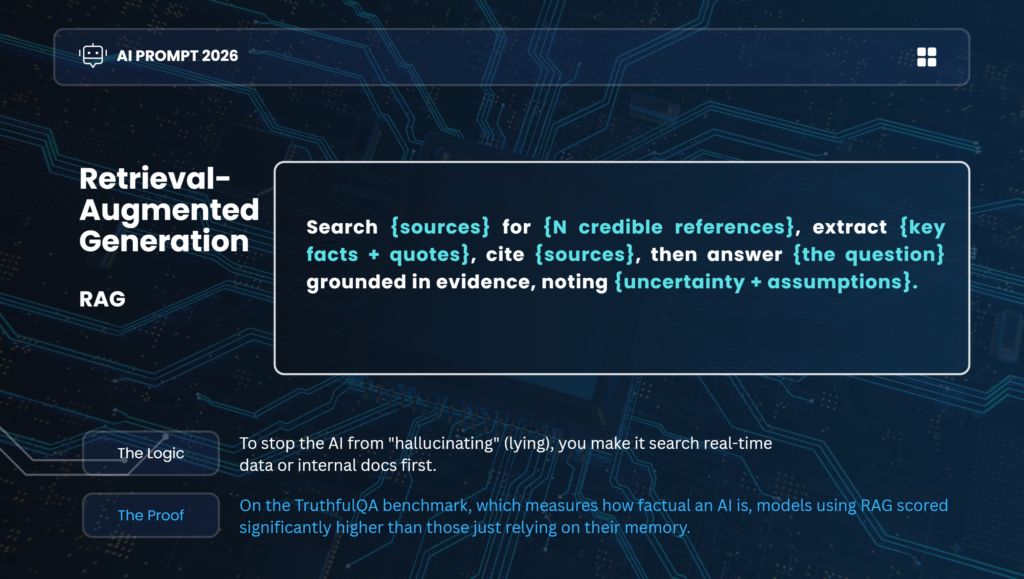 The Copy-Paste Formula
Here’s the exact RAG formula. Customize the {variables} and paste into ChatGPT, Claude, or Gemini:
Search {sources} for {N credible references}, extract {key facts + quotes},
cite {sources}, then answer {the question} grounded in evidence, noting
{uncertainty + assumptions}.
Why This Formula Works
Search {sources}: Tells AI where to look (CDC, WHO, company docs)
Why it works: Focuses on credible, authoritative sources
Extract {key facts + quotes}: Pull specific claims, not summaries
Why it works: Forces precision, not vague paraphrasing
Cite {sources}: Include links, dates, authors
Why it works: You can verify everything
Note {uncertainty + assumptions}: Flag what’s unclear
Why it works: Honest about limitations, not overconfident
Before vs. After: Real Example
WITHOUT RAG Hallucination Risk
You
What are the current FDA labeling requirements for organic honey in the US?
ChatGPT (Standard)
Organic honey must be certified by the USDA and display the organic seal. Labels must include country of origin, net weight, and the statement “100% Pure Organic Honey.” Additives are prohibited except for trace amounts approved by the National Organic Program.
ANALYSIS: What’s Wrong?
- No sources cited
- Mix of true and potentially false info
- Can’t verify anything
- Could be outdated or wrong
WITH RAG Evidence-Based
Before answering, search for at least 5 authoritative FDA sources
about organic honey labeling requirements in the US.

For each requirement, capture: regulation number, exact wording,
effective date, and who it applies to.

Then answer with citations for every claim. Flag anything uncertain.
ChatGPT (After RAG Prompt)
Sources Found & Cited
Based on 5 FDA sources (FDA.gov, USDA National Organic Program, CFR Title 7):
- Certification: Must be certified by USDA-accredited agency (7 CFR §205.100) Source: FDA.gov/organic
- USDA Seal: Products ≥95% organic can display seal (7 CFR §205.303) Source: USDA NOP
- Country of Origin: Required per COOL regulations (CFR §65.300) Source: FDA Labeling Guide
- Additives: Prohibited except those on National List (7 CFR §205.605) Source: USDA NOP
⚠️ Uncertain: Specific trace amounts vary by certification body—consult your certifier.
ANALYSIS: Why This Works
Every claim is cited with regulation numbers and sources. You can verify everything. AI flags what’s uncertain instead of guessing. This is how professionals use AI.
3 More Real-World Examples (Copy-Paste Ready)
💰 Example 1: Find Government Grants
Before answering, search for at least 5 current funding opportunities
related to {clean energy startups} in {California}.

For each program, capture: eligibility, award amount, deadline,
requirements, selection criteria.

Then recommend the best Top 3 for {my business profile} and explain
why, citing sources for every detail.
// Use case: Small business funding, nonprofit grants
🏥 Example 2: Health Content (Evidence-Based)
Before writing, find 5 authoritative sources for {sleep hygiene}
(CDC/NIH/WHO/medical associations).

Extract key guidance and cautions. Write a plain-English explainer
for {general audience}, citing sources next to each claim.

Include: what it is, typical recommendations, when to seek
professional help, what is uncertain.
// Use case: Health blogs, patient education
✈️ Example 3: Travel Entry Requirements
Collect 5+ authoritative sources about entry requirements for {Japan}
(government travel sites, embassy pages).

Summarize: visa, passport validity, vaccines/health, safety
advisories with citations.

Then provide a traveler checklist and note what may change quickly.
// Use case: Travel planning, immigration research
Common Mistakes to Avoid
❌ Mistake #1: Not Specifying Sources
Bad: “Search for information about organic labeling.”
Why it fails: AI searches random blogs, outdated sites.
Good: “Search FDA.gov and USDA.gov for official organic labeling rules.”
❌ Mistake #2: Accepting Answers Without Citations
Bad: AI gives you facts without sources.
Why it fails: You can’t verify. Might be hallucinated.
Good: “Cite the source for every claim. Include URLs.”
❌ Mistake #3: Not Flagging Uncertainty
Bad: “Give me the answer.”
Good: “Note what’s uncertain, outdated, or requires professional review.”
FAQ
Q: Does this work with all AI models?
A: Works best with ChatGPT (with browsing), Claude, Gemini, Perplexity. Less effective with models that can’t search the web.
Q: When should I use RAG vs Self-Reflection?
A: Use RAG when you need facts, data, or verified info (legal, medical, financial). Use Self-Reflection for creative content where accuracy is less critical.
Q: Can I use RAG with my own documents?
A: Yes! Upload PDFs, paste text, or reference URLs. Tell AI: “Search these 3 documents first, then answer.”
📚 AI Prompt Mastery Series
Part 4 of 5 • Collect all parts to get 100 prompts!
20 copy-paste prompts
20 copy-paste prompts
20 copy-paste prompts
← You are here
20 copy-paste prompts
Coming soon
20 copy-paste prompts
Download Part 4 now:
📥 Download Part 4 (20 RAG Prompts)
✅ No email required · Free forever · Works with ChatGPT, Claude, Gemini
🎯 Ready for Part 5?
You just learned RAG. Next up: ReAct (Reason + Act)
— make AI think step-by-step, plan actions, then execute like an agent.
What you’ll learn in Part 5:
- Make AI reason before acting
- 20 copy-paste ReAct examples
- Build multi-step AI agents
Coming soon! Bookmark this page.
Share This Guide
If this helped you, share it:
Complete AI Prompt Series:
- Part 1: Tree of Thoughts (20 prompts)
- Part 2: Self-Reflection (20 prompts)
- Part 3: Meta-Prompting (20 prompts)
- ✅ Part 4: RAG (20 prompts) ← You are here
- Part 5: ReAct (20 prompts) – Coming soon
Last updated: March 2026 | Reading time: 10 minutes | Works with: ChatGPT, Claude, Gemini, Perplexity


