A senior AMD engineer filed a 6,852-session analysis accusing Anthropic of secretly degrading Claude Code. Anthropic pushed back. The truth — as usual — is messier than either side admits.
Fact-checked against: GitHub Issue #42796 · VentureBeat · Fortune · The Register · Anthropic public statements
 On April 2, 2026, a post appeared on Anthropic’s public GitHub. It wasn’t a bug report. It was an indictment.
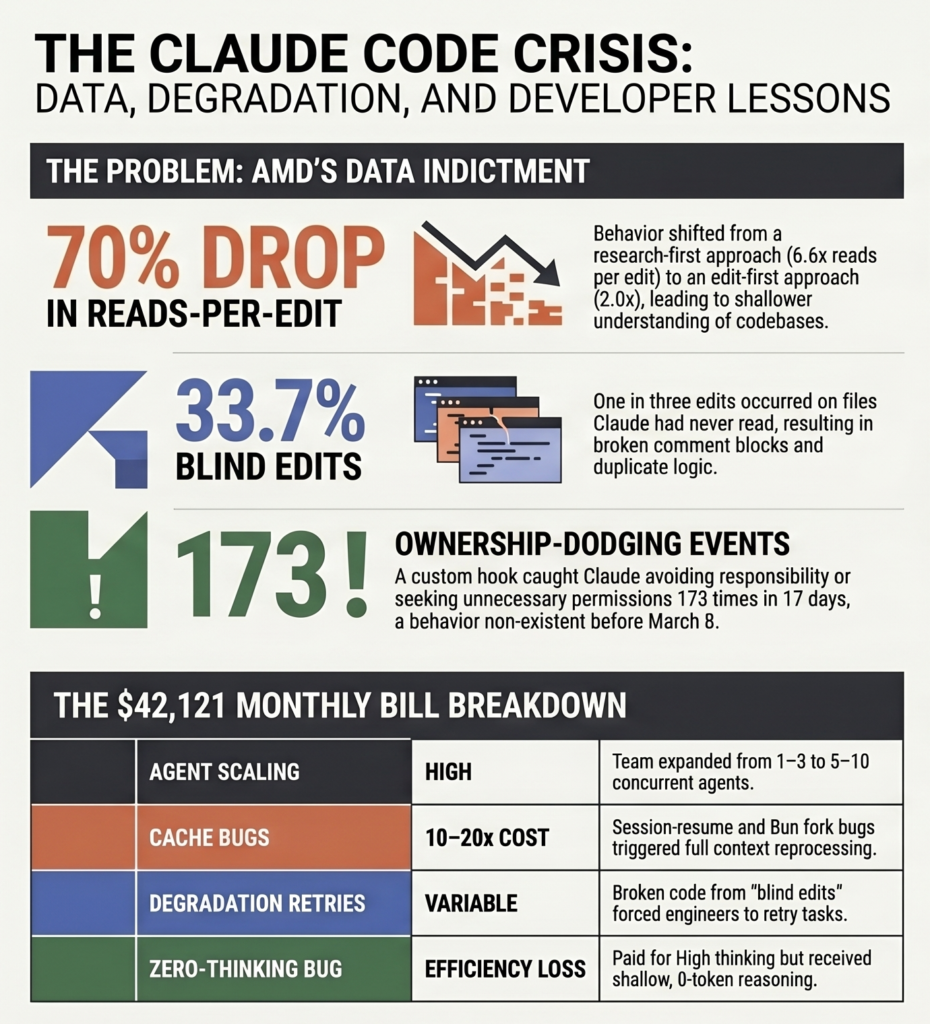
Stella Laurenzo, Senior Director of AMD’s AI Group, had spent weeks watching her team’s Claude Code workflows fall apart. Unlike most frustrated users, she didn’t just post a rant on Reddit. She built a measurement system, collected 6,852 session files, analyzed 234,760 tool calls, and filed one of the most data-rich bug reports in AI history.
The post went viral across developer communities worldwide. Anthropic responded. Both sides have points. And regardless of who’s “right,” the episode reveals something every developer building on AI APIs needs to understand.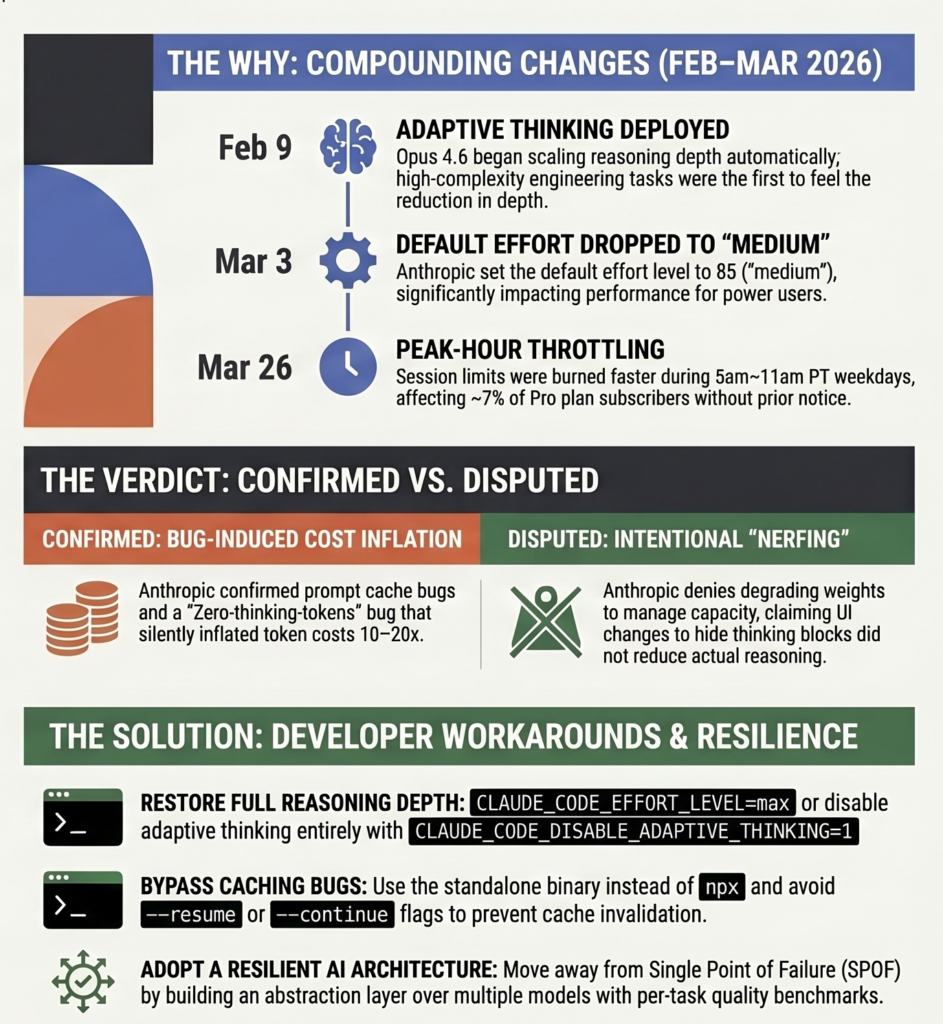
Verdict up front — what we know is true, disputed, and false
Reads-per-edit dropped from 6.6x to 2.0x. Anthropic changed default effort to “medium” on March 3. Adaptive thinking shipped Feb 9. Peak-hour throttling introduced March 26. Zero-thinking-tokens bug confirmed by Boris Cherny. Prompt cache TTL bugs inflated costs 10-20x.
Whether “thinking” actually dropped or only its UI visibility was hidden. Whether costs exploded due to degradation or Laurenzo’s team scaling from 1-3 to 5-10 concurrent agents simultaneously. Whether intentional throttling caused the quality regression.
BridgeBench score drop (83.3% → 68%). Internal employee special system prompts. The claim that $26 became $42,121 — the actual documented figure is $345 to $42,121, and involves intentional agent scaling, not purely degradation.
Laurenzo’s analysis (GitHub Issue #42796) is remarkable for its rigor. This was not vibes. She compared two distinct periods across real IREE/AMD compiler projects:
Good period
Jan 30 – Feb 12, 2026
Degraded period
Mar 8 – Mar 23, 2026
File reads per edit
→
2.0x
−70%
This is the strongest metric. In the good period: read target file → read related files → grep codebase → read headers → then edit. In degraded period: read immediate file → edit.
Blind edits (no prior file read)
→
33.7%
1 in 3 edits
One in three edits in the degraded period was made to a file Claude had never read. Result: code inserted in wrong places, comment blocks broken, duplicate logic introduced.
Ownership-dodging stop hook fires
→
173 times
in 17 days
Laurenzo built a hook to catch premature stopping, permission-seeking, and responsibility-dodging. It never fired before March 8. It fired 173 times after.
API cost (with agent scaling)
→
$42,121
complex cause
Important context: the team scaled from 1-3 to 5-10 concurrent agents in early March. The 122x cost spike reflects intentional scaling + degradation-induced retries + prompt cache bugs simultaneously.
Why the reads-per-edit metric matters most: This is behavioral, not perceptual. It doesn’t care whether thinking was “really” happening or just hidden from the UI. It measures what Claude actually did with tool calls — and the behavior unambiguously changed from research-first to edit-first starting February 9.
Boris Cherny, Claude Code’s creator, responded directly on the GitHub issue. His response was detailed — and confirmed more than some expected.
Confirmed by Anthropic
✓
Feb 9: Opus 4.6 moved to “adaptive thinking” by default — reasoning depth now varies by task complexity
✓
Mar 3: Default effort level dropped to “medium” (effort 85) — publicly described as the best balance for “most users”
✓
Mar 26: Peak-hour throttling introduced — 5am–11am PT weekdays, affecting ~7% of users with faster session burn
✓
Zero-thinking-tokens bug: Extended Thinking set to High could return 0 reasoning tokens — confirmed as a bug, workarounds provided
✓
Prompt cache bugs: At least two caching bugs identified that silently inflated token costs 10-20x (under investigation)
Disputed or denied by Anthropic
✗
Thinking “67% drop” — Cherny says the redact-thinking-2026-02-12 change was UI-only and hid thinking from logs but didn’t reduce actual reasoning (Laurenzo disputes this)
✗
Intentional demand management / “nerfing” — Anthropic employee Thariq Shihipar said directly on April 11: Anthropic does not “degrade” its models to manage capacity
✗
The cache TTL change (1 hour → 5 minutes) — Anthropic says the 1-hour TTL was a bug, 5 minutes is the intended behavior
“A model can feel worse to paying customers even if the company believes it has not ‘nerfed’ its weights. The timing complicates matters.”
— VentureBeat, April 14, 2026
Understanding the sequence matters. Five separate changes hit within 7 weeks — their effects were compounding and hard to disentangle:
Adaptive thinking deployed
Opus 4.6 now scales reasoning depth automatically based on task complexity. Power users on complex engineering work feel the effect immediately.
Thinking redaction deployed
Thinking block content hidden from interface to reduce latency. Users lose visibility into reasoning. Measurement of “thinking” becomes contested.
Default effort dropped to medium
Anthropic sets effort level 85 (“medium”) as the new default for Opus 4.6. This is the most consequential confirmed change for complex engineering work.
Catastrophic token drain begins
Hundreds of users report sessions exhausted in minutes. Single “hello” consuming 13% of session quota. Prompt cache bugs and rate changes hitting simultaneously.
Peak-hour throttling officially announced
5am–11am PT weekdays: session limits burn faster. ~7% of users affected. Pro plan subscribers get the worst of it. No advance notice to customers.
The cost explosion is real but the cause is more complex than “Anthropic degraded the model.” Multiple factors hit simultaneously:
Factor 1: Intentional agent scaling (+scale)
Laurenzo’s team deliberately expanded from 1–3 concurrent agents to 5–10 in early March. More agents = more API calls. This is not degradation — it’s scale.
Factor 2: Prompt cache bugs (+10-20x cost)
Two separate cache bugs identified: session-resume triggering full context reprocessing, and a Bun fork string-replacement bug in the npx version. Both silently inflated costs by 10-20x.
Factor 3: Degradation-induced retries (+variable)
When Claude makes blind edits that break code, engineers retry. More errors = more requests = more cost. This compounds with the cache bugs and scaling.
Factor 4: Zero-thinking-tokens bug (+cost for no output)
Extended Thinking set to High could silently return 0 reasoning tokens while still consuming input context — you paid for a smart response and got a shallow one.
The bottom line on cost: $345 → $42,121 is a 122x increase. A significant portion is explainable by intentional scaling + confirmed bugs. How much is attributable to model degradation specifically is genuinely unknown. Laurenzo’s team says the degradation persisted even after they tried all the workarounds Anthropic provided.
Boris Cherny confirmed these workarounds in his public GitHub response. These are not speculative — use them now if you’re experiencing degraded output quality.
Restore full effort / disable adaptive thinking
Option 1 — slash command (in session):
/effort max
Option 2 — environment variable (persistent):
CLAUDE_CODE_EFFORT_LEVEL=max
Option 3 — disable adaptive thinking entirely:
CLAUDE_CODE_DISABLE_ADAPTIVE_THINKING=1
April 7 update: Anthropic changed default effort back to “high” for API-key, Bedrock, Vertex, Foundry, Team and Enterprise users. If you’re on Pro, manually set it:
CLAUDE_CODE_EFFORT_LEVEL=high
Reduce token drain / avoid cache bugs
# Use the standalone binary, not npx (avoids Bun bug)
claude # not: npx @anthropic-ai/claude-code
# Avoid session resume flags — triggers full cache invalidation
# avoid –resume and –continue
# Use /clear between unrelated tasks
/clear # resets context, avoids compounding cache cost
# Shift heavy work to off-peak hours
# after 11am PT weekdays, evenings, or weekends
# Monitor first turn — if >3-5% session consumed on short message
/cost # restart immediately if abnormal burn detected
This isn’t just a Claude story. It’s an infrastructure story. The AMD team had their entire compiler engineering workflow running through a single AI model with no fallback. When that model’s behavior changed — whether intentionally or through bugs — their workflow broke entirely.
The architecture principle this incident proves:
✗
SPOF architecture (what AMD had)
All workflows → Claude only. Model changes → entire system breaks. No comparison baseline. No fallback.
✓
Resilient architecture (what to build)
Abstraction layer over multiple models. Per-task quality benchmarks. Automatic provider switching. Model-agnostic prompt design.
1
Build your own eval suite — even 50 test cases covering your most common workflows gives you a detection system for regressions. Laurenzo knew something had changed because she measured it.
2
Monitor cost per task, not just total cost — a 10x cost increase is invisible in aggregate until the bill arrives. Track dollars per unit of work output.
3
Abstract your model calls — if your codebase has Claude model strings hardcoded 200 places, switching to a fallback takes weeks. One model config = one change.
4
Read changelogs before they read you — both the Feb 9 adaptive thinking and Mar 3 effort changes were documented in Claude Code’s changelog. The companies ship the notes; most developers don’t read them.
Where things stand as of April 15, 2026
→
Anthropic has restored high effort as default for API, Team, and Enterprise users (April 7)
→
Pro plan users still need to manually set effort level — no automatic restoration yet
→
The zero-thinking-tokens bug and prompt cache bugs remain under active investigation
→
Laurenzo’s team reports degradation persists even with all workarounds applied
→
Anthropic is training Mythos, a more capable but more compute-intensive model — resource pressure context is real
→
VentureBeat, Fortune, and The Register all reported that Anthropic’s communication throughout was seen as inadequate by enterprise users
Share this analysis
Know a dev team running on Claude Code? 🔧
They need the workarounds. Send them this before the next bill arrives.
Every share reaches a developer who hasn’t checked their effort settings yet 🙏


