
Google your own name right now. Go ahead. Whatever came up — that’s your digital reputation, and most of it you didn’t put there.
A developer in Turkey going by @vibeeval posted a thread on X on May 14, 2026 that went viral for one reason: he’d spent a weekend cleaning up his entire digital footprint using Claude as his lawyer, research assistant, and writing tool — and it worked. 47 data broker listings removed. 12 dormant accounts deleted. 3 negative search results buried. In six hours.

His last line in the thread: “Bu işlem 6-7 saat sürdü. Claude olmasaydı 6-7 hafta sürerdi.” This took 6-7 hours. Without Claude it would have taken 6-7 weeks.
This guide documents exactly how he did it — every step, every prompt, copy-paste ready — plus a 2026 update that makes data broker removal significantly faster than when he did it.
The numbers from @vibeeval’s weekend
 Why This Actually Works: The Law Is on Your Side
 Why This Actually Works: The Law Is on Your Side
This isn’t a hack. It’s not a loophole. The legal foundation is solid — and it just got stronger.
🇺🇸 CCPA (California Consumer Privacy Act)
Any company doing business in California must delete your personal data on request — regardless of where you live. Since most major data brokers are US-based, CCPA applies globally. You don’t need to be a California resident to invoke it against a California-registered company.
🇪🇺 GDPR (General Data Protection Regulation)
EU residents have the “right to erasure” under Article 17. Any company processing your data must delete it on request with limited exceptions. Response required within 30 days.
🆕 California DROP Platform — New in 2026
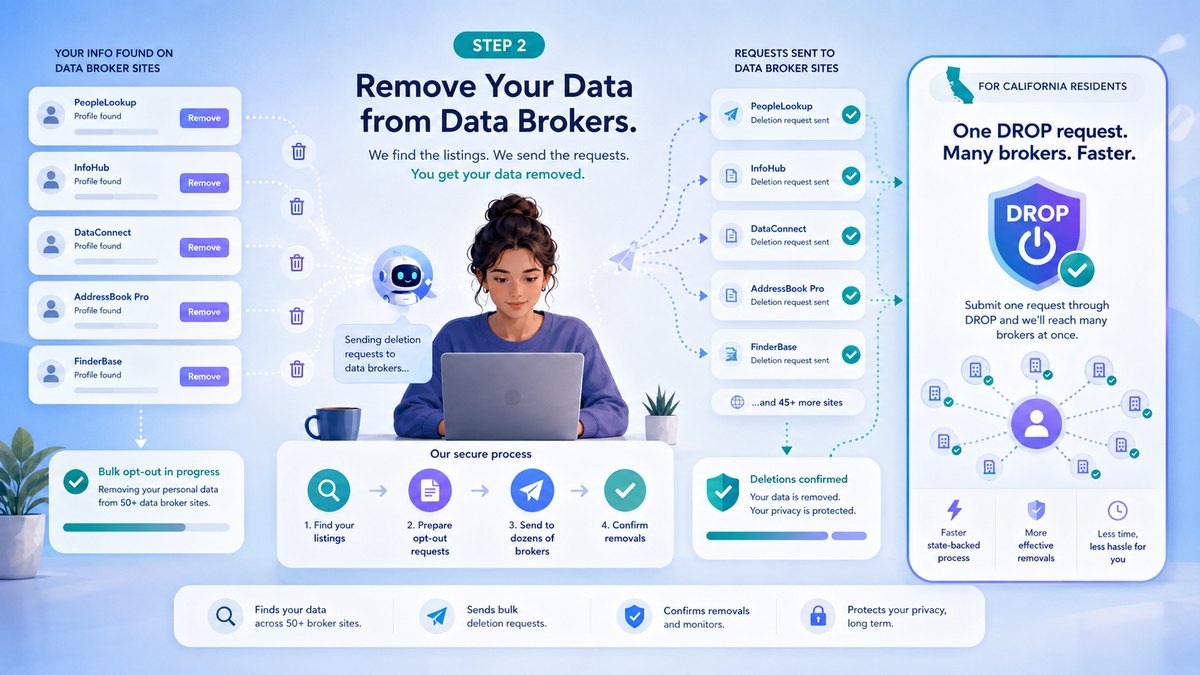
As of January 1, 2026, California residents can use the state’s new Delete Request and Opt-Out Platform (DROP) to submit one request that goes to every registered data broker simultaneously. Starting August 1, 2026, brokers are legally required to delete your data within 90 days. If you’re a California resident, this alone replaces hours of manual opt-out work.
The reason Claude makes this so much faster: every data broker uses a different opt-out process, different forms, and different email addresses. Doing this manually takes weeks of research per company. Claude generates the correct legal language for each one in seconds — and knows which jurisdiction applies.
Step 1 — Find Out What’s Actually Out There
 Step 1 — Find Out What’s Actually Out There
Before you can clean anything, you need a complete picture. Most people are shocked by what comes up. Search Google for your full name, email address, and phone number — in quotation marks, one at a time. Screenshot every results page.
Also search: your name + city, your name + old employer, your name + username you’ve used before. Then paste all of it into Claude and ask for a prioritized hit list.
📋 Claude Prompt — Step 1
Look at these search results: [paste your Google results here].
Categorize them into:
1. Data brokers (sites selling my personal info)
2. Social media accounts
3. Old dormant accounts
4. News articles or forum posts
Then rank each category by deletion priority — most urgent first. For each item, tell me: what kind of information is exposed, how dangerous it is to leave up, and what I should do about it.
Step 2 — Remove Your Data from Data Brokers
Data brokers are the low-hanging fruit. Sites like Spokeo, BeenVerified, Whitepages, MyLife, and Intelius are legally required to remove your data when you ask. The problem is each one has a different process. Claude generates the right request for each one.
The biggest ones to hit first: Spokeo, BeenVerified, Whitepages, MyLife, Intelius, PeopleFinder, TruthFinder, Instant Checkmate, US Search, PeopleLookup. These 10 account for the majority of public personal data exposure.
📋 Claude Prompt — Step 2 (US/Global)
Write a CCPA opt-out and deletion request to send to this data broker: [broker name].
My information:
– Full name: [your name]
– Email: [your email]
– Address: [your address]
Include:
– Legal references to CCPA Section 1798.105
– Professional, firm tone
– Request for confirmation of deletion within 45 days
– Statement that I do not consent to any further sale or sharing of my data
📋 Claude Prompt — Step 2 (EU/GDPR)
Write a GDPR Article 17 erasure request to [company name].
My information:
– Full name: [your name]
– Email: [your email]
Include:
– Reference to GDPR Article 17 (Right to Erasure)
– Request for response within 30 days as required by Article 12
– Request for confirmation of all data categories held and their deletion
– Professional tone
🆕 California Residents: Use DROP First
If you’re a California resident, skip writing individual broker requests. Go to privacy.ca.gov/drop and submit a single deletion request that hits all registered data brokers simultaneously. Starting August 1, 2026, brokers must delete your data within 90 days. This one action replaces hours of individual opt-out work.
Step 3 — Delete the Forgotten Accounts
That forum you registered for in 2014 to ask one question? It still has your email, your username, probably your original password pattern. If that site gets breached, whoever gets the dump now has a key to test against your current accounts.
Go to justdeleteme.xyz — it rates websites by how hard they make it to delete your account. Find the services you registered with and use Claude to get the exact deletion procedure, not just a deactivation.
📋 Claude Prompt — Step 3
I want to permanently delete my account on [service name].
Give me:
1. The exact steps to request full deletion (not just deactivation)
2. The URL or contact method for the deletion request
3. What data they’re required to delete vs. what they may retain
4. A deletion confirmation email template I can send if they try to offer “deactivation” instead of deletion
5. How long they typically take to process this
Step 4 — Use Legal Language That Companies Actually Respond To
“Please delete my information” gets ignored. A request citing the specific legal statute with a response deadline and a consequence clause does not.
@vibeeval’s key insight was that companies treat legalese seriously because it signals someone who knows their rights and will escalate. Claude writes that language in seconds. Pick the law that applies to your jurisdiction:
🇺🇸
US (California): CCPA Section 1798.105 — deletion right. DROP platform for bulk requests from August 2026.
🇪🇺
EU/EEA: GDPR Article 17 — Right to Erasure. 30-day response requirement.
🇬🇧
UK: UK GDPR / Data Protection Act 2018 — same erasure rights as EU GDPR post-Brexit.
🇹🇷
Turkey: KVKK Article 7 — same right to erasure. @vibeeval’s original jurisdiction.
🇰🇷
South Korea: Personal Information Protection Act (PIPA) Article 36 — right to correction and deletion.
📋 Claude Prompt — Step 4 (adapt to your law)
Write a formal personal data deletion request to [company name] based on [CCPA / GDPR Article 17 / PIPA Article 36 — choose your law].
My information:
– Full name: [name]
– Email: [email]
The request must include:
– Specific legal statute with article number
– Identity verification clause
– 30-day response deadline
– Statement that failure to comply may result in regulatory complaint
– Professional, formal tone
Step 5 — If You Can’t Delete It, Bury It
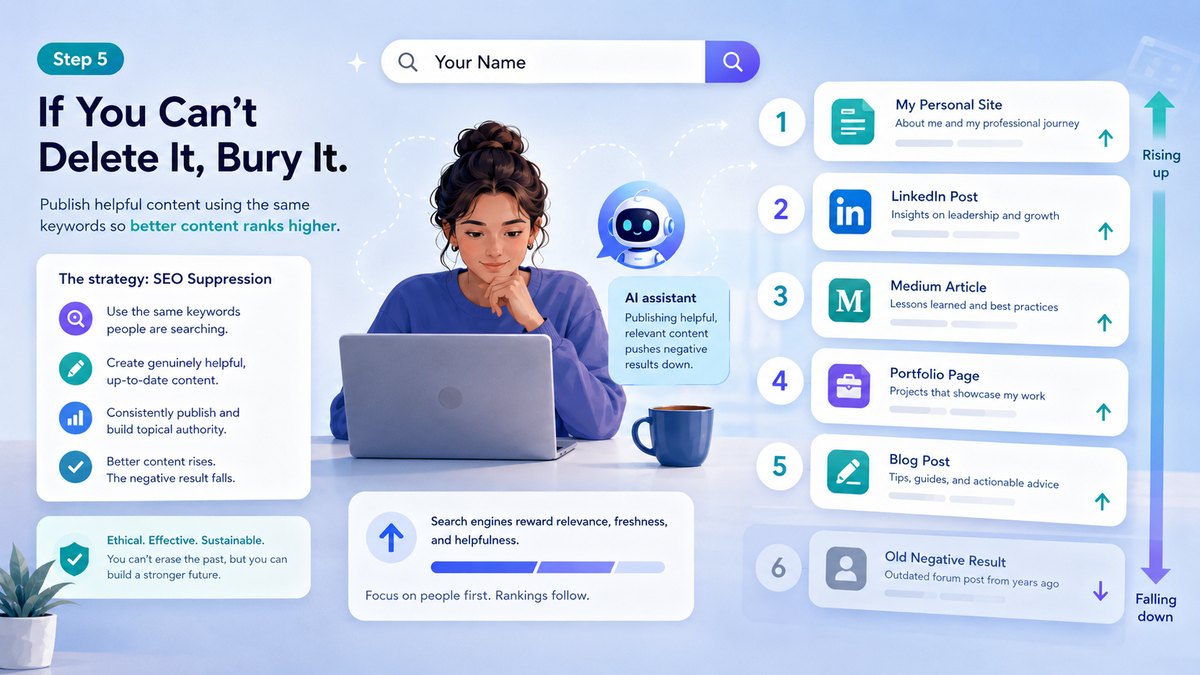
Old news articles, forum threads from a decade ago, Wayback Machine snapshots — these often can’t be deleted. The site owns them. Google won’t remove them unless there’s a specific legal basis. So you take a different approach: SEO suppression.
You create 5-7 pieces of content using the exact same keywords as the negative result. Google ranks fresh, authoritative content higher — over time, the old result gets pushed to page 2 or 3, where nobody looks. This isn’t deception. It’s giving Google better signal about who you are now.
📋 Claude Prompt — Step 5
I need to push down this search result: [paste URL or describe the page].
My name: [name]
My profession: [job title / field]
Create 5 different content ideas I could publish that:
1. Use the same keywords as that negative result
2. Are genuinely useful to people in my field (not fake content)
3. Could rank above the negative result over time
For each idea, give me: the title, the keyword focus, where I should publish it (LinkedIn, personal site, Medium, etc.), and an estimated time to write. Prioritize the ones most likely to rank quickly.
Step 6 — Find Out What’s Already Been Stolen
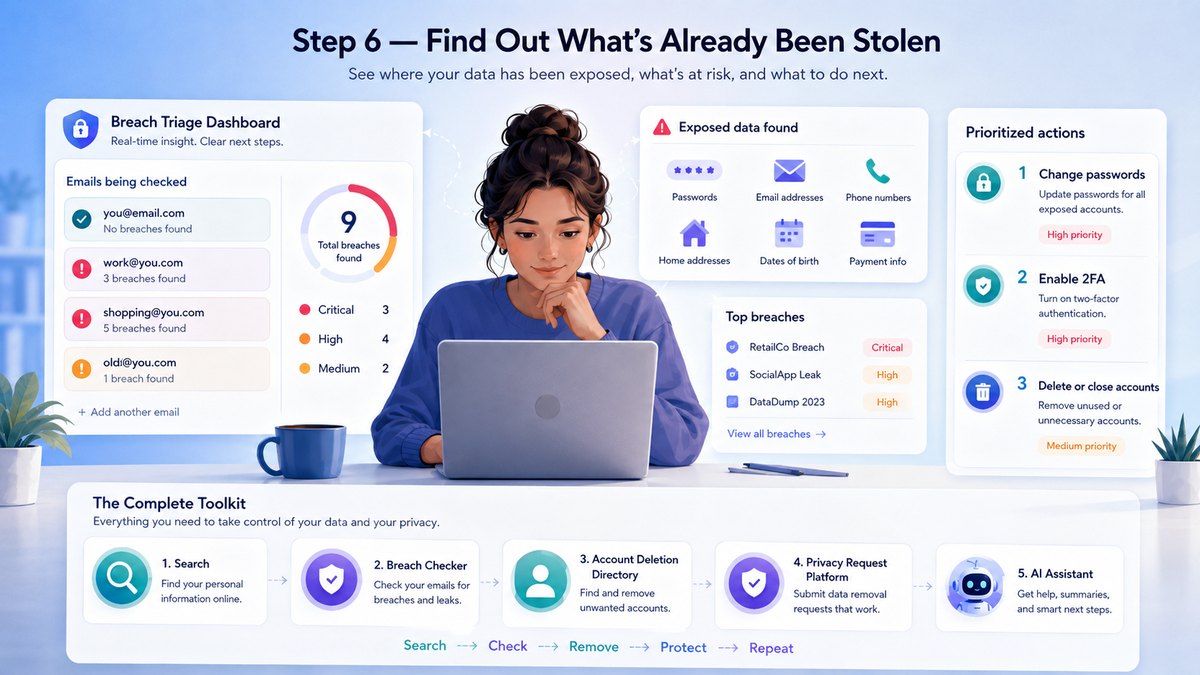
Go to haveibeenpwned.com and enter every email address you’ve ever used. The site checks against a database of 14+ billion breached accounts. You’ll probably find more than you expected.
Each breach entry shows what data was exposed: email, password hash, phone, address, even browsing history in some cases. Paste the full list into Claude and ask for a triage plan — not all breaches require the same response.
📋 Claude Prompt — Step 6
Here’s my data breach history from haveibeenpwned: [paste the full list].
For each breach, tell me:
1. How serious it is (high/medium/low) and why
2. Whether I should: change the password, enable 2FA, or fully delete the account
3. What specific data was exposed and what that means for my risk
Then give me a prioritized action list — what to do today vs. this week vs. eventually.
Start with the ones that create the most immediate risk (financial accounts, email access, SSO login providers).

The Complete Toolkit
| Tool | What it does | Cost |
|---|---|---|
| Google (yourself) | Your starting inventory — what’s actually out there | Free |
| haveibeenpwned.com | Check which of your emails appeared in data breaches | Free |
| justdeleteme.xyz | Difficulty rating for deleting accounts on 500+ services | Free |
| privacy.ca.gov/drop 🆕 | Single request deletes all CA data brokers (CA residents) | Free |
| Claude | Legal language, deletion procedures, SEO strategy — all of it | Free / Claude.ai |
⚠️ What to Expect Realistically
It works — but it takes follow-up. Data brokers are legally required to delete your data, but some don’t do it on first request. Give it 30-45 days, then check again and follow up with a second request citing the deadline they missed.
New data accumulates. Your information gets re-added to brokers periodically. This isn’t a one-time fix — run this process once a year.
CCPA applies to US-based companies. If the data broker is based outside the US, CCPA won’t help — you need GDPR (EU companies), UK GDPR, or your country’s specific law. Claude will tell you which applies when you describe the company.
@vibeeval’s conclusion was right. This used to require a lawyer, a developer, and six weeks. The legal frameworks existed. The tools existed. What was missing was someone to draft the right language for each company, identify the right legal statute for each jurisdiction, and organize the entire process into a manageable sequence.
That’s what Claude does here. Your data is legally yours. The law says so. You just needed a way to say it correctly — and now you have all six prompts to do it.
Google your name before you share this.
Then send it to someone whose name you just searched and found something they’d want removed.
Written by the MindWiredAI team. The original 6-step thread was posted by @vibeeval (digital ghost) on X on May 14, 2026 and reported by IBTimes UK and The News Pakistan. Legal frameworks verified against CCPA text (California Civil Code 1798.105), GDPR Article 17, California DROP platform (privacy.ca.gov/drop, effective January 1, 2026), and CPPA official documentation. DROP consumer deletion processing requirement (August 1, 2026, 90-day window) sourced directly from cppa.ca.gov. haveibeenpwned.com and justdeleteme.xyz are real, free third-party services. The Karpathy quote and Turkish/KVKK legal reference reflect the original X thread. South Korea PIPA Article 36 added for Korean-language audience applicability.


