May 17, 2026 — API is now live, DALL-E 3 has been retired, 4K support added, Azure/Microsoft Foundry launch, and per-image pricing confirmed. Originally published April 22, 2026.
 OpenAI shipped GPT Image 2 on April 21, 2026 — no launch event, no hype cycle. Just a model that immediately took the largest lead in Image Arena history. Four weeks later, the API is live, DALL-E 3 has been officially retired, 4K resolution support is in beta, and Microsoft put it on Azure. Here’s the complete, current picture.
GPT Image 2 — Key Numbers

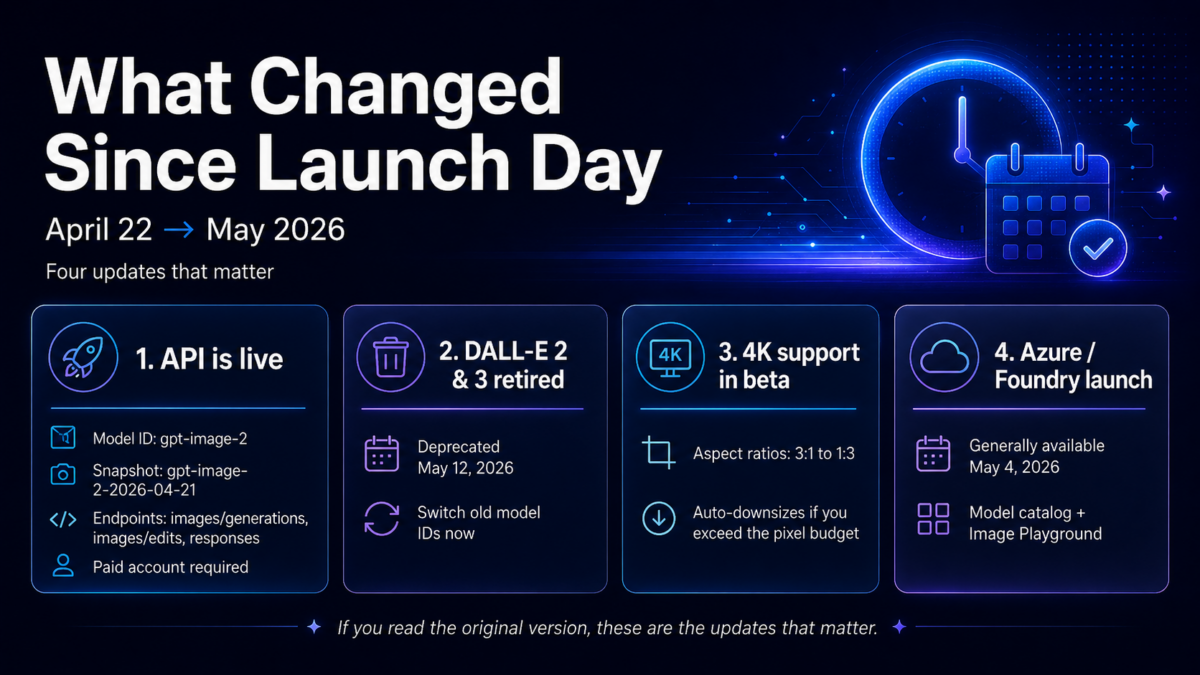
What Changed Since Launch Day (April 22 → May 2026)
Four things moved in the month since we first published this. If you read the original, these are the updates that matter.
The API opened in early May as scheduled. Production snapshot: gpt-image-2-2026-04-21. Available via v1/images/generations, v1/images/edits, and v1/responses endpoints. Free tier not supported — requires a paid account.
Both models were deprecated on May 12. GPT Image 2 is now the default across ChatGPT and the API. If you have any production code calling dall-e-3 or dall-e-2 as a model ID, it’s broken right now. Switch to gpt-image-2 or use the alias chatgpt-image-latest if you want auto-updates.
4K output is available through the API in beta. Aspect ratios supported: 3:1 wide to 1:3 tall. If your requested resolution exceeds the pixel budget, the service auto-downsizes. The intelligent routing layer automatically selects from six token size buckets (16, 24, 36, 48, 64, 96) mapping to legacy size tiers.
GPT-image-2 is now generally available on Microsoft Foundry. Enterprise teams on Azure can deploy directly from the model catalog and experiment in the Image Playground. This is the enterprise route for teams that can’t use the OpenAI API directly.
 What Actually Changed: 5 Things That Explain the Lead
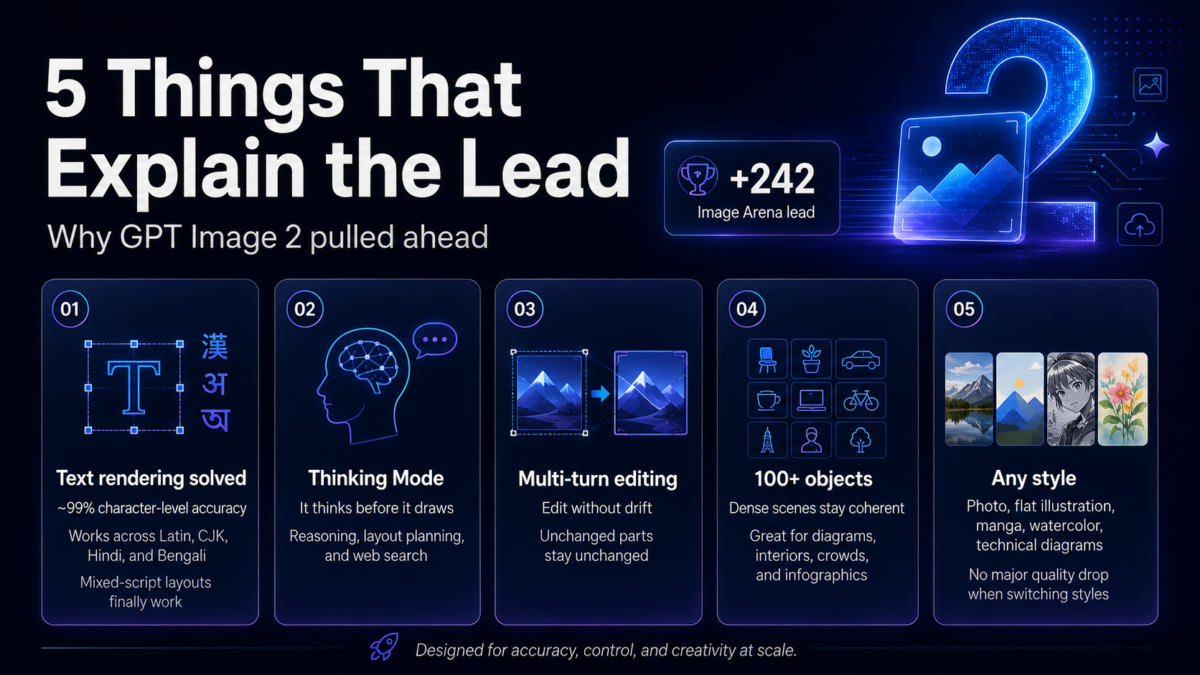 What Actually Changed: 5 Things That Explain the Lead
The 242-point Arena lead isn’t a rounding error. These five changes explain it — and why each one matters for actual work.

Text rendering is finally solved — in every language
~99% character-level accuracy across Latin, CJK, Hindi, and Bengali scripts. The deeper improvement is mixed-script handling — a Japanese poster with Latin product names, an Arabic menu with Western prices, Chinese subtitles over English titles. Mixed-script layouts have been broken in every commercial image model until now. If your work involves any image with text — menus, infographics, UI mockups, localized ad assets — this is the update you’ve been waiting for.
DALL-E 3 / GPT Image 1.5
“enchilada” → “enchuita”
“burrito” → “burrto”
“churro” → “churiros”
GPT Image 2
Print-ready menu: correct spelling, accurate pricing format, multilingual labels. Verified by independent reviewers.
It thinks before it draws — industry first
GPT Image 2 is the first image model to integrate O-series reasoning capabilities. Before generating, it researches, plans, reasons about layout, and can search the web in real time. This is “Thinking Mode” — not a filter, but built into the architecture itself.
Instant Mode
Standard generation. Available to all users including Free. Good for quick work.
Thinking Mode
Reasoning + web search before generating. Requires Plus or Pro. Best quality.
Multi-turn editing without drift
Edit an image across multiple turns and the unchanged parts stay unchanged. Previous models would gradually alter unrelated elements — the lighting, background colors, object positions — with each successive edit. GPT Image 2 tracks what you asked it to change and leaves everything else intact.
100+ distinct objects in a single scene
Complex, dense scenes with many individual elements — infographics, store interiors, crowd scenes, technical diagrams — render coherently. Previous models would lose track of object count or start merging elements when scene complexity exceeded a threshold. GPT Image 2 doesn’t have that ceiling in the same way.
Any style without quality drop
Photorealism, flat illustration, manga, watercolor, technical diagram — the model handles style-switching without the quality degradation that hit previous models when you moved away from photorealistic defaults. VentureBeat confirmed it renders manga, infographics, maps, and slides “seemingly flawlessly” in testing.
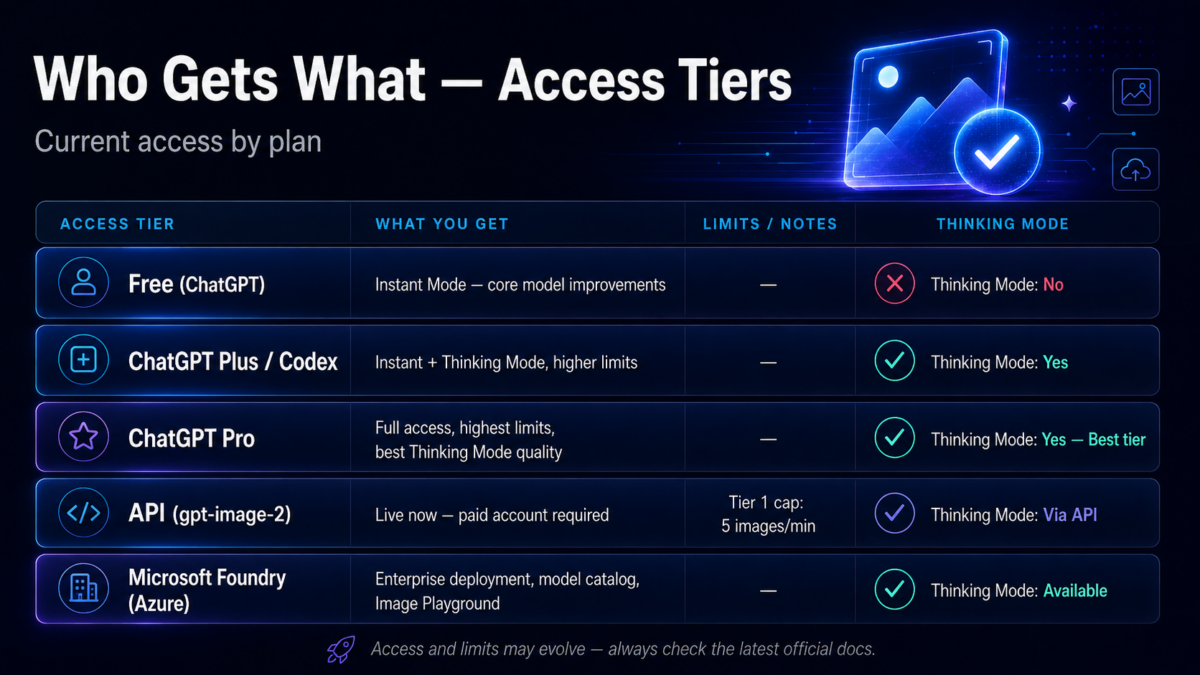
Who Gets What — Access Tiers (Current)
 Who Gets What — Access Tiers (Current)
| Tier | What you get | Thinking Mode |
|---|---|---|
| Free (ChatGPT) | Instant Mode — core model improvements | ❌ No |
| ChatGPT Plus / Codex | Instant + Thinking Mode, higher limits | ✅ Yes |
| ChatGPT Pro | Full access, highest limits, best Thinking Mode quality | ✅ Best tier |
| API (gpt-image-2) | Live now — paid account required, Tier 1 cap: 5 images/min | ✅ Via API |
| Microsoft Foundry (Azure) | Enterprise deployment, model catalog, Image Playground | ✅ Available |
API Pricing — What It Actually Costs Per Image
 API Pricing — What It Actually Costs Per Image
GPT Image 2 uses token-based pricing — same structure as text models. The headline rates are per million tokens, but here’s what that translates to per image at 1024×1024:
| Token type | Rate | Per 1024×1024 image |
|---|---|---|
| Image Input | $8 / M tokens | Reference image cost when editing |
| Image Cached | $2 / M tokens | Repeated reference image (75% cheaper) |
| Image Output — Low | $30 / M tokens | ~$0.006 per image |
| Image Output — Medium | $30 / M tokens | ~$0.053 per image |
| Image Output — High | $30 / M tokens | ~$0.211 per image |
Text input is billed separately at $5/M tokens. For typical prompts, this adds negligible cost. Edits with reference images add image input tokens on top of output costs — run your actual workload through the calculator before assuming simple per-image pricing applies.
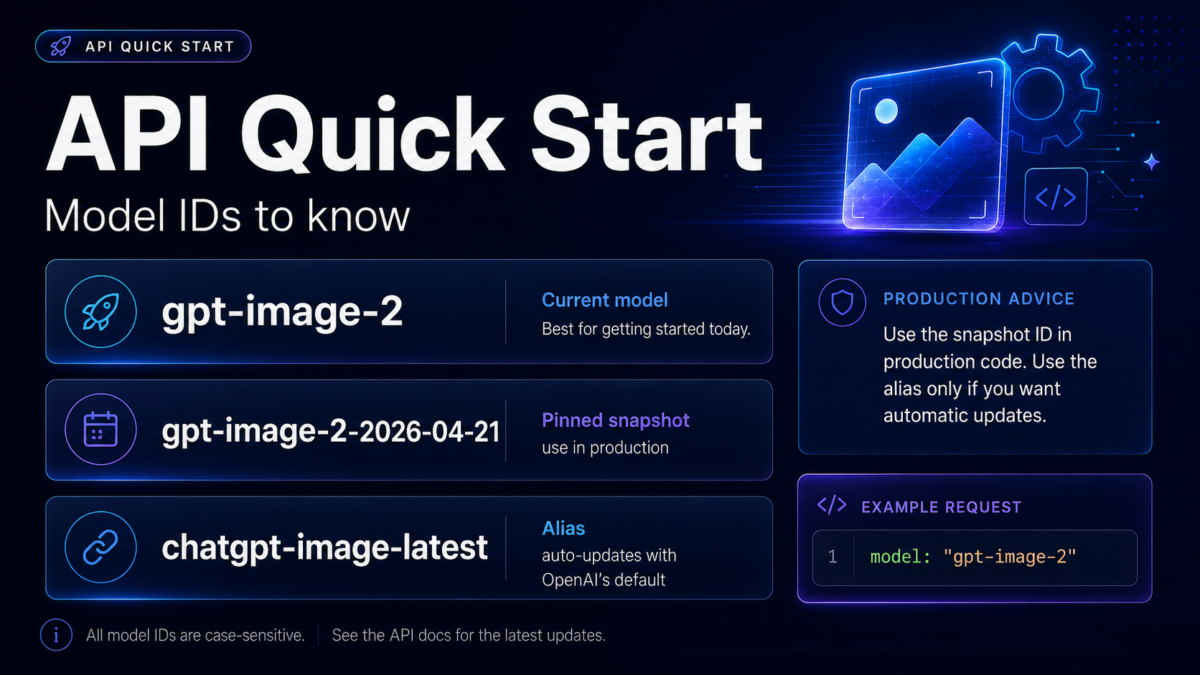
API Quick Start
 API Quick Start
Two model identifiers to know. Use the snapshot if you want pinned behavior. Use the alias if you want automatic updates.
Model IDs
gpt-image-2 # current model
gpt-image-2-2026-04-21 # pinned snapshot (use in production)
chatgpt-image-latest # alias — auto-updates with OpenAI’s default
Production advice: Use the snapshot ID in production code. The chatgpt-image-latest alias rolls forward when OpenAI publishes new versions — that’s not behavior you want changing under a live batch job.
Known Limitations (Updated)
 Known Limitations (Updated)
Thinking Mode gated to Plus/Pro. Free users get Instant Mode only. The biggest quality improvements — reasoning, web search, self-correction — require a paid subscription.
No transparent backgrounds via the Responses tool. If your workflow requires PNG with alpha channel transparency, this API path doesn’t support it yet. Check the images endpoint instead.
Tier 1 API rate limit: 5 images/minute. Low for batch workflows. Rate limits scale with usage tier. Plan for this before building high-throughput pipelines on a fresh API account.
Streaming, function calling, and structured outputs not supported. Listed as unsupported on the model page. If your architecture depends on any of these, you need a workaround.
Knowledge cutoff: December 2025. The model correctly renders most current brand logos and cultural references, but anything after December 2025 may be inaccurate. Thinking Mode’s web search can compensate — but only when that mode is active.
Precise physical manipulation still inconsistent. Repositioning a specific hand, adjusting pixel-level placement, fine motor-detail edits — these still produce unpredictable results.
⚠️ DALL-E 3 Is Retired — If Your Code Is Still Calling It, It’s Broken
DALL-E 2 and DALL-E 3 were both deprecated on May 12, 2026. Any production code still using dall-e-3 as the model ID is returning errors right now.
Migration: replace dall-e-3 with gpt-image-2. GPT Image 1.5 remains accessible via the API for legacy integrations but is no longer the default.
The one-month summary: GPT Image 2 shipped as the most capable image model available, the API is live, the old models are gone, and 4K is in beta. The Thinking Mode quality gap between free and paid is real — if you care about the best output, you need Plus or Pro. For API users, the per-image costs are reasonable at low and medium quality; high quality starts adding up fast on volume.
The competition angle is still interesting. Nano Banana Pro (Gemini 3 Pro Image) launched in February and remains the closest competitor. For teams doing high-volume work, it’s worth benchmarking both with your actual prompts before committing.
Still using DALL-E 3 in production?
It was retired May 12. Send this to whoever maintains the API calls — the migration is one model ID change.
Originally published April 22, 2026. Updated May 17, 2026. Updates verified against: OpenAI official announcement (openai.com/index/introducing-chatgpt-images-2-0), OpenAI API model documentation (gpt-image-2 model page), Microsoft Community Hub / Azure Foundry blog (May 4, 2026), VentureBeat (April 21, 2026), TechCrunch (April 21, 2026), WaveSpeed AI builder review (April 2026), apiyi.com complete guide, fal.ai model documentation. Per-image pricing from WaveSpeed AI builder analysis and apiyi.com. DALL-E retirement date confirmed via OpenAI deprecation documentation.


