📋 Fact-Check Note
All numbers in this post are verified against OpenAI’s official announcement, the GPT-5.5 System Card (April 23, 2026), and independent coverage from CNBC, TechCrunch, Fortune, VentureBeat, and Axios. The original source material contained several inaccuracies — corrections are noted at the end.
OpenAI’s release cadence is no longer measured in quarters. GPT-5 launched in August 2025. GPT-5.4 shipped March 5, 2026. GPT-5.5 arrived April 23 — just six weeks later. That’s not a typo. The pace is deliberate: Anthropic released Claude Opus 4.7 on April 16, took over the leaderboard in several benchmark categories, and OpenAI had its answer in production exactly one week later.
OpenAI co-founder Greg Brockman called GPT-5.5 “a new class of intelligence” and “a big step towards more agentic and intuitive computing” during a press briefing. That’s the company framing. Here’s the substance.
The most important thing to understand first: GPT-5.5 is the first fully retrained base model since GPT-4.5. Every GPT-5.x release between them — 5.1, 5.2, 5.3, 5.4 — was a post-training iteration on top of the same base. GPT-5.5 is not. This is a ground-up rebuild, which is why the benchmark gaps over 5.4 are larger than typical point releases.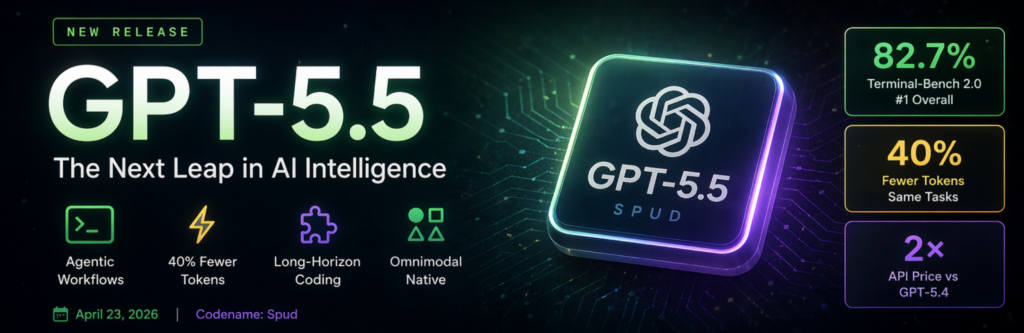
These are the changes that explain the benchmark gaps — and the ones that matter in daily use.
Instead of carefully managing every step, you can give GPT-5.5 a messy, multi-part task and trust it to plan, use tools, check its work, navigate through ambiguity, and keep going. This is the key behavioral shift — it’s not just smarter answers, it’s fewer interruptions.
The gains are especially strong in agentic coding, computer use, knowledge work, and early scientific research — areas where progress depends on reasoning across context and taking action over time.
GPT-5.5 matches GPT-5.4 per-token latency in real-world serving, while performing at a much higher level of intelligence. It also uses significantly fewer tokens to complete the same Codex tasks.
GPT-5.5 uses about 40% fewer output tokens to finish the same Codex task. That’s the number OpenAI is using to justify the price doubling — and it’s worth doing the math: if a task takes 40% fewer tokens, the effective cost increase on that task is closer to 20% than 100%, despite the per-token rate doubling from $2.50 to $5.
⚡ The real math on the price hike:
OpenAI introduced Expert-SWE as a new internal benchmark where tasks have a 20-hour median human completion time. GPT-5.5 notably outperformed GPT-5.4 on this metric while using significantly fewer tokens.
Early testers said GPT-5.5 shows a stronger ability to understand the shape of a system: why something is failing, where the fix needs to land, and what else in the codebase would be affected. The quote that circulated most from early access: “The first coding model I’ve used that has serious conceptual clarity.”
One major architectural upgrade contributes to this directly: long-context retrieval (MRCR v2) at 1M tokens goes from 36.6% in GPT-5.4 to 74.0% in GPT-5.5 — more than doubling. The model doesn’t just have a larger context window — it uses it better.
GPT-5.5 is natively omnimodal — processing text, images, audio, and video in a single unified architecture. Previous models handled modalities via separate components bolted together. The integration is at the base model level, which is why visual reasoning scores improved alongside coding scores from the same release.
Caveat: audio and video modalities are newer and early reports show some rough edges compared to the text and image performance. The omnimodal architecture is a foundation — the modality maturity is uneven at launch.
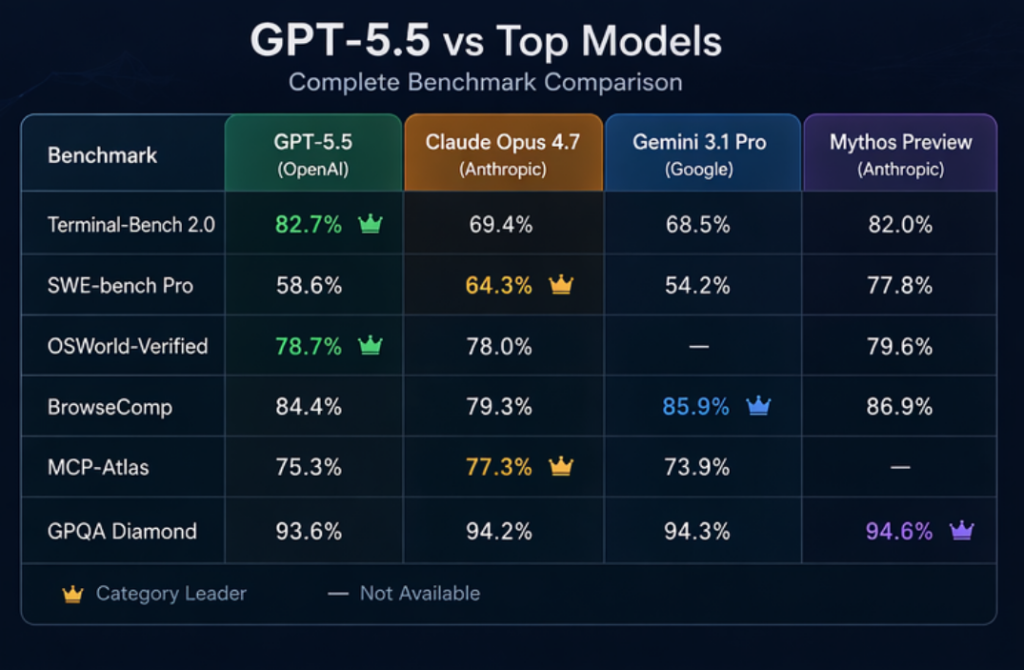 The Complete Benchmark Picture
From the original source document + verified against OpenAI’s official announcement. Green = category leader.
| Benchmark | GPT-5.5 | Opus 4.7 | Gemini 3.1 Pro | Mythos Preview |
|---|---|---|---|---|
| Terminal-Bench 2.0 | 82.7% ⭐ | 69.4% | 68.5% | 82.0% |
| SWE-bench Pro | 58.6% | 64.3% ⭐ | 54.2% | 77.8% |
| OSWorld-Verified | 78.7% ⭐ | 78.0% | — | 79.6% |
| BrowseComp | 84.4% | 79.3% | 85.9% ⭐ | 86.9% |
| MCP-Atlas | 75.3% | 77.3% ⭐ | 73.9% | — |
| Finance Agent v1.1 | 61.5% | 64.4% ⭐ | 59.7% | — |
| CyberGym | 81.8% | 73.1% | — | 83.8% ⭐ |
| GPQA Diamond | 93.6% | 94.2% | 94.3% | 94.6% ⭐ |
| MMLU (Multilingual) | 83.2% | 91.5% ⭐ | — | — |
| HLE (no tools) | 41.4% | 46.9% ⭐ | 44.4% | 56.8% |
Source: OpenAI official announcement + benchmark table from source document, cross-verified April 23–24, 2026. Mythos Preview is Anthropic’s restricted/gated model — not generally available.
Long-context retrieval (MRCR v2)
Computer use (OSWorld, narrowly)
FrontierMath Tier 4 (35.4% vs 22.9%)
CyberGym (vs Opus — not vs Mythos)
MMLU multilingual (91.5% vs 83.2%)
MCP-Atlas tool orchestration
Finance Agent v1.1
HLE no-tools reasoning
The pattern: GPT-5.5 leads on planning-and-execution — Terminal-Bench, computer use, long-horizon coding. Opus 4.7 leads on codebase-resolution — SWE-Bench, MCP-Atlas, multilingual understanding. They are not competing on the same axis.
| Plan / Tier | What You Get | GPT-5.5 Pro? |
|---|---|---|
| ChatGPT Free | Not available at launch. Consumer rollout TBD. | No |
| ChatGPT Plus ($20/mo) | GPT-5.5 + Thinking. ~200 messages/week. | No |
| ChatGPT Pro ($200/mo) | GPT-5.5, Thinking, and GPT-5.5 Pro access | Yes ✓ |
| Business / Enterprise | Full access including 5.5 Pro | Yes ✓ |
| Codex (CLI/IDE/web) | Available to Plus, Pro, Business, Enterprise, Edu, Go. 400K context window. | Pro tier only |
| API (gpt-5.5) | Live as of April 24. 1M context window. Responses + Chat Completions APIs. | gpt-5.5-pro available |
$30 / 1M output tokens
Batch/Flex: 50% off
Priority: 2.5× rate
$180 / 1M output tokens
For highest accuracy tasks
Pro/Business/Enterprise only
Context window: 1M tokens in the API, 400K in Codex. Codex fast mode runs 1.5× faster at 2.5× the cost.
On Artificial Analysis’s AA-Omniscience benchmark, GPT-5.5 (xhigh) hits the highest recorded accuracy at 57% — but also the highest hallucination rate at 86%. By comparison, Opus 4.7 scores 36% hallucination rate, and Gemini 3.1 Pro Preview is at 50%.
OpenAI self-reports a 60% reduction in hallucinations versus GPT-5.4 in their own benchmarks. Third-party independent verification is still in progress. If your workload has high hallucination cost — legal, medical, financial, compliance — test GPT-5.5 thoroughly before replacing GPT-5.4 or Opus 4.7. Early production reports from teams focused on factual accuracy show the quality improvement is real but not decisive in every context.
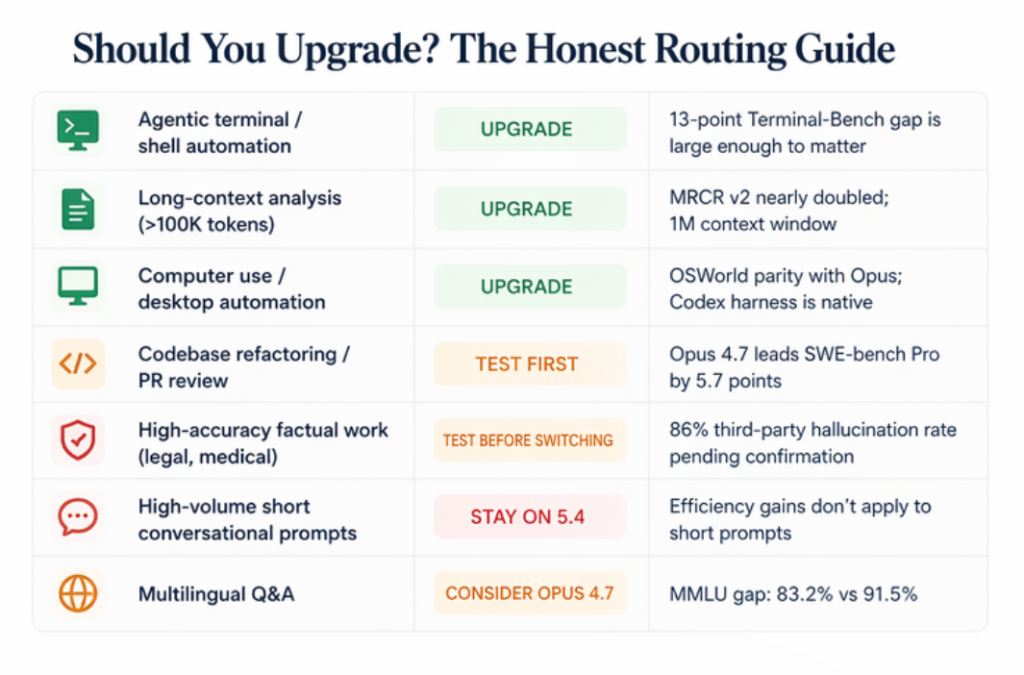 Should You Upgrade? The Honest Routing Guide
| Your workload | Recommendation | Reason |
|---|---|---|
| Agentic terminal / shell automation | Upgrade | 13-point Terminal-Bench gap is large enough to matter in production |
| Long-context analysis (>100K tokens) | Upgrade | MRCR v2 nearly doubled; 1M context window |
| Computer use / desktop automation | Upgrade | OSWorld parity with Opus; Codex harness is native |
| Codebase refactoring / PR review | Test first | Opus 4.7 leads SWE-bench Pro by 5.7 points — real gap for IDE-integrated work |
| High-accuracy factual work (legal, medical) | Test before switching | 86% third-party hallucination rate pending independent confirmation |
| High-volume short conversational prompts | Stay on 5.4 | Efficiency gains don’t apply to short prompts; 2× price hike hits full force |
| Multilingual Q&A | Consider Opus 4.7 | MMLU gap is notable: GPT-5.5 at 83.2% vs Opus at 91.5% |
📋 Corrections to the Original Source Material
Already using GPT-5.5 in production? Drop your real-world results in the comments — especially curious about the hallucination rates people are seeing in non-benchmark use.


