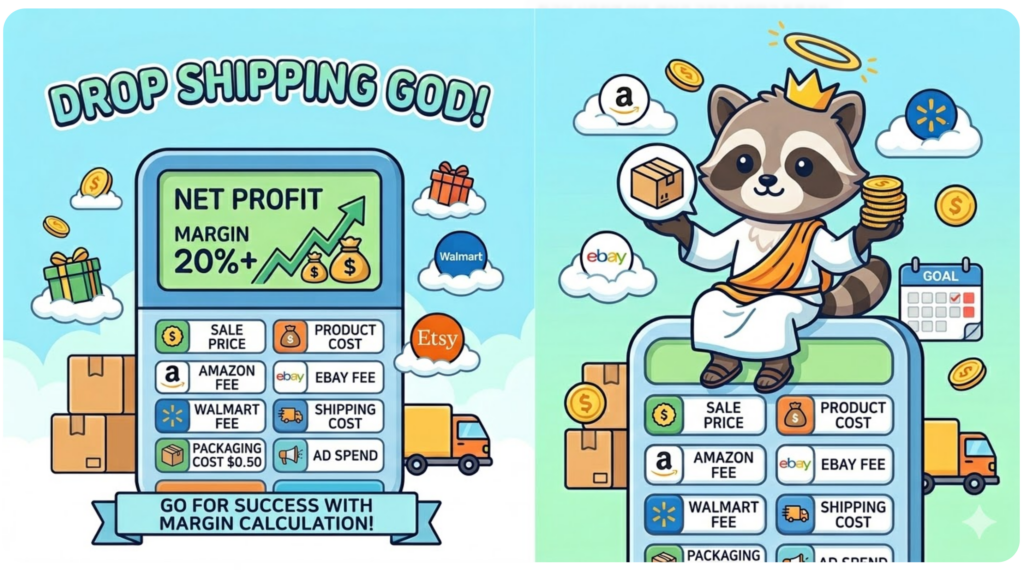
Here’s something most new dropshippers get wrong: they calculate profit by simply subtracting product cost from sale price. But that’s only half the story. Once you factor in platform referral fees, payment processing, shipping, advertising spend, and packaging — that “$15 profit” you thought you had might actually be $3. Or worse, negative.
15%
Amazon’s referral fee alone
5–10%
Margin difference between platforms
$0.50
Packaging costs most sellers forget
I’ve seen too many sellers realize this after they’ve already listed 50 products and spent $200 on ads. The fix is simple: run the numbers before you commit. That’s exactly what this calculator does — with real platform fee structures built in.
What This Calculator Actually Does
This isn’t one of those “enter two numbers and get a result” calculators. It’s built specifically for US dropshippers selling on the platforms that matter — Amazon, eBay, Walmart, and Etsy — with real fee structures baked in.
📊
Real Platform Fees
Amazon’s 15% referral, eBay’s 13.25% FVF, Walmart’s tiered rates, Etsy’s 6.5% + listing fee — all pre-loaded
🎯
Monthly Goal Planner
Set a profit target and see exactly how many units you need to sell per day
⚡
Cross-Platform Compare
See which platform gives you the best margin for the same product — side by side
📄
PDF Export
Download a clean profit analysis report to save, print, or share with your team
How to Use It
1
Pick your platform. Click Amazon, eBay, Walmart, Etsy, or set a custom fee. Each platform’s actual fee structure loads automatically.
2
Enter your sale price and product cost. That’s the price your customer pays, and what your supplier charges you.
3
Add shipping, packaging, and ad spend. These are the costs most people forget. Don’t skip them — they change everything.
4
Set a monthly goal (optional). Want $3,000/month? The calculator tells you how many units per day that takes.
5
Read your results. Net profit, margin %, ROI, and a profitability gauge — everything updates in real time as you type.
▸ Interactive Tool
Free · No Signup
💡 All calculations happen in your browser. Nothing is stored or sent anywhere.
Why Most Margin Calculators Get It Wrong
Most free calculators online ask you for sale price and cost, then give you a margin. That’s useless for dropshipping. Here’s why:
Amazon
~15%
referral fee on most categories
eBay
13.25%
final value fee + $0.30/order
Walmart
6–15%
varies by category
Etsy
6.5%
+ 3% processing + $0.20 listing
These aren’t small numbers — they can easily wipe out your profit if you’re selling low-ticket items. This calculator accounts for all of it. You pick a platform, the real fee structure loads automatically. And the cross-platform comparison table shows you — at a glance — which marketplace gives you the best margin for the exact same product.
Quick example: Selling a $49.99 product that costs you $22 from the supplier. On Amazon, after the 15% referral fee ($7.50), shipping ($4.50), and packaging ($0.50), your actual profit is $15.49 — not the $27.99 you might have assumed. On Walmart with a lower 8% referral, that same product nets you $19.00. That’s a $3.51 difference per unit.
💡 Pro Tips for Better Margins
→ Test the same product across all 5 platforms before deciding where to list. The margin difference can be 5–10% or more.
→ Don’t ignore packaging costs. Even $0.50 per unit adds up to $500 at 1,000 orders — that’s pure profit lost.
→ Use the monthly goal planner backwards: if you need 200 units/day to hit your goal, the product might not be worth pursuing.
→ Target 20%+ margin minimum. Below that, a single return or ad spend increase can push you negative.
→ Download the PDF report for every product you’re considering. Compare them side by side before committing budget.
When to Walk Away From a Product
The profitability gauge at the bottom of the calculator isn’t just decoration. If it shows “Low” or “Risky” — meaning your margin is under 10% — that’s a clear signal. Either renegotiate your supplier cost, raise your sale price, or find a different product entirely.
⚠️
The most common mistake in dropshipping isn’t picking bad products. It’s picking almost-good products with margins too thin to survive real-world costs. One unexpected return, one ad campaign that underperforms, and you’re in the red. Always validate the numbers first.
A good rule of thumb: if you can’t hit at least 20% margin after ALL costs — including fees, shipping, packaging, and a realistic ad budget — it’s time to move on to the next product. There are thousands of products out there. Don’t get attached to one that doesn’t make math work.
📌
Bookmark This Page
Run the numbers before every new product you list. This calculator is free, works in your browser, and never asks for your email. Come back anytime.
More Free Tools
💜
Subscription & Bill Tracker — Track every recurring payment and find what to cancel